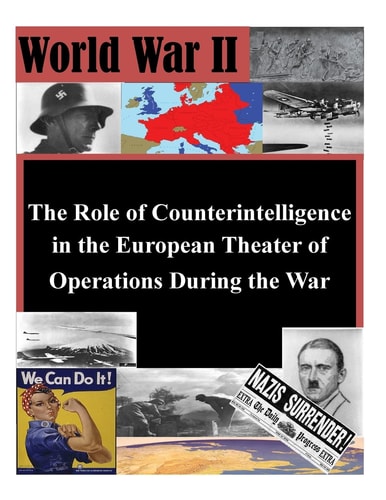
The Role of Counterintelligence in the European Theater of Operations During the War
0
0
As an Amazon Associate and affiliate partner, Menrva Books earns from qualifying purchases. Learn more
Author Description
This book is an historical analysis of US Army counterintelligence in the European Theater of Operations (ETO) during World War II. The book reviews the organization, doctrine, missions, and equipment of counterintelligence units to determine their impact on operations in the ETO, Germany. This book also reviews the same topics for counterintelligence operations prior to World War II to determine significant changes that may have affected operations in World War II. This work concludes that the decision to place counterintelligence assets with combat units from the division to theater level was the most significant decision of the war for US Army counterintelligence. The lack of a coherent doctrine, organization, and training program significantly reduced the ability of the Counter Intelligence Corps (CIC) to contribute to the war effort in the ETO prior to 1943. As the result of wartime experience and doctrine developed in 1943, the CIC became proactive, making significant contributions to counter the German Intelligence Service at both the operational and tactical levels. Based on these lesson learned, the study makes recommendations for the future of counterintelligence in the US Army as the 21st century approaches.
Menrva's Summary
THE THESIS
This book investigates the pivotal role of U.S. Army counterintelligence within the European Theater of Operations during World War II. It examines the evolution of counterintelligence units, their organizational structures, operational doctrines, and equipment, assessing their impact on wartime activities in the ETO and Germany. The analysis extends to pre-war counterintelligence efforts to identify critical changes that influenced WWII operations, ultimately concluding that integrating counterintelligence assets directly with combat units at all levels was the war's most significant decision for U.S. Army counterintelligence.
THE SCOPE MAP
- Analysis of US Army counterintelligence organization, doctrine, missions, and equipment in the European Theater of Operations (ETO) during World War II.
- Review of counterintelligence operations prior to World War II to identify significant changes affecting WWII operations.
- Assessment of the impact of counterintelligence units on operations in the ETO and Germany.
- Examination of the Counter Intelligence Corps (CIC) effectiveness, noting its reduced contribution prior to 1943 due to a lack of coherent doctrine, organization, and training.
- Evaluation of the CIC's transformation into a proactive force after 1943, making significant contributions against the German Intelligence Service at operational and tactical levels.
- Identification of key lessons learned from WWII counterintelligence experiences.
- Recommendations for the future of counterintelligence in the US Army, looking towards the 21st century.
THE AUTHORITY PERSPECTIVE
This historical analysis is grounded in the specific context of U.S. Army counterintelligence during World War II. The work's conclusion highlights the strategic importance of integrating counterintelligence with combat units, a finding derived from detailed examination of organizational and doctrinal developments. The study acknowledges initial limitations of the Counter Intelligence Corps (CIC) before 1943, contrasting this with its later proactive contributions. The author's recommendations for future counterintelligence efforts suggest a forward-looking perspective informed by historical experience.
Page Count:
158
Publication Date:
2015-12-26
Publisher:
CreateSpace Independent Publishing Platform
ISBN-10:
1522923063
ISBN-13:
9781522923060
Non-Fiction
History
Military History
Community Tags
Similar Books