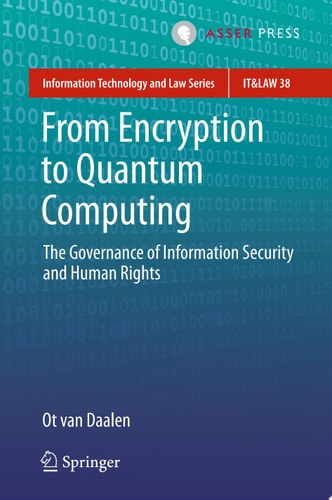
From Encryption to Quantum Computing
0
0
As an Amazon Associate and affiliate partner, Menrva Books earns from qualifying purchases. Learn more
Author Description
This book examines the implications of information security which plays such an important role in modern digital infrastructure. Information security technologies restrict the (mis)use of this infrastructure, while also constantly being probed by researchers, intelligence agencies and criminals. One can see this cycle of making and breaking everywhere in the digital sphere. An important example of this cat-and-mouse game is the development of quantum computers, which may in the near future break some widely used encryption technologies. This cycle also has implications for human rights: weakening encryption may affect privacy, for example. But the relationship between human rights and information security has not been investigated in-depth before. In this study, state obligations relating to information security are analysed under the European Convention for Human Rights and the EU Charter for Fundamental Rights, focusing on issues as human rights-compatible encryption policy, on how governments should deal with vulnerabilities in software, and whether governments can curtail the development and export of quantum computers. This book analyses the human rights-compatibility of quantum computing governance and offers unique insights into the connection between human rights and information security that will be relevant for legal practitioners, policy-makers and academics involved in this field of research. Ot van Daalen is Assistant Professor at the Institute for Information Law (IViR), Faculty of Law of the University of Amsterdam, the Netherlands.
Menrva's Summary
THE THESIS
This book investigates the complex interplay between information security, the advent of quantum computing, and their implications for human rights. The author, Ot van Daalen, an Assistant Professor at the University of Amsterdam, analyzes the constant cycle of developing and breaking digital security technologies. The study specifically examines state obligations under the European Convention for Human Rights and the EU Charter for Fundamental Rights, focusing on issues such as human rights-compatible encryption policies, government responses to software vulnerabilities, and the regulation of quantum computer development and export.
THE SCOPE MAP
- Analysis of information security's role in modern digital infrastructure.
- Exploration of the cat-and-mouse game between security measures and their breaches.
- Detailed examination of quantum computing's potential to break current encryption.
- In-depth investigation into the relationship between human rights and information security.
- Analysis of state obligations under the European Convention for Human Rights and the EU Charter for Fundamental Rights.
- Discussion on human rights-compatible encryption policy.
- Consideration of government approaches to software vulnerabilities and quantum computer export controls.
THE AUTHORITY PERSPECTIVE
This book offers unique insights into the connection between human rights and information security, particularly in the context of emerging quantum computing technologies. It is structured to be relevant for legal practitioners, policy-makers, and academics involved in this specialized field. The author's academic position suggests a rigorous, research-driven approach to the subject matter. The detailed analysis of legal frameworks and policy implications indicates a text aimed at professionals seeking a comprehensive understanding of these critical issues.
Page Count:
367
Publication Date:
2024-09-01
Publisher:
Springer Nature
ISBN-10:
9462656355
ISBN-13:
9789462656352
Science
Politics
Non-Fiction
Information Security
Human rights
Law
Community Tags
Similar Books