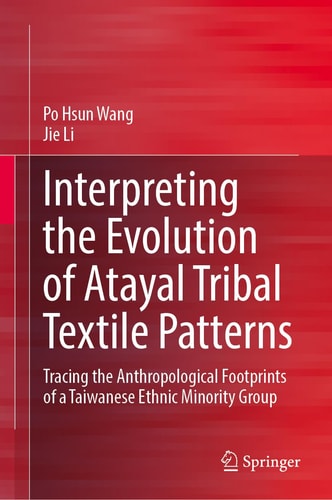
Interpreting the Evolution of Atayal Tribal Textile Patterns: Tracing the Anthropological Footprints of a Taiwanese Ethnic Minority Group
0
0
As an Amazon Associate and affiliate partner, Menrva Books earns from qualifying purchases. Learn more
Author Description
This book elucidates findings from an anthropological study that analyzes the patterns of Taiwan's Atayal tribe’s fabric in their ethnic dress codes. By analyzing the changes and development of the patterns over time, the authors draw fascinating conclusions regarding the geographical migration and intermarriage practices between indigenous minority groups in Taiwan’s history. The book brings new insights within East Asian linguistic anthropology in theorizing about the origins of legends and broader patterns of ethnic migration, integrating the characteristics and relationships among Atayal fabrics, and interpreting these relationships in connection with the flow of sub-ethnic groups. In doing so, the book provides rich empirical evidence for anthropologists and migration scholars to better understand the movement of ethnic groups in Taiwan, while also establishing a model for how studying textile design can be employed to establish such linkages. The book shows that the composition and changes of ethnic minority patterns have their own internal logic and causes. By studying this, the authors demonstrate how such work might translate intangible and tangible culture into explicit and shareable knowledge and provide a compass for other anthropologists and researchers in the fields of visual and linguistic anthropology, migration studies, and ethnic and indigenous cultures, in Asia and beyond.
Menrva's Summary
THE THESIS
This book investigates the historical evolution of Atayal tribal textile patterns as a means to trace the migration and intermarriage practices of a Taiwanese ethnic minority group. The authors, Jie Li and Po Hsun Wang, draw upon anthropological study to analyze the changes and development of patterns in Atayal ethnic dress codes over time. Their research integrates Atayal fabric characteristics with broader patterns of ethnic migration in East Asian linguistic anthropology, offering new insights into the origins of legends and the movement of indigenous groups. The book provides empirical evidence for anthropologists and migration scholars, establishing a model for how textile design can illuminate cultural linkages and the internal logic of pattern composition and change.
THE SCOPE MAP
- Analysis of Atayal tribe's fabric patterns in ethnic dress codes.
- Tracing geographical migration and intermarriage practices of indigenous minority groups in Taiwan.
- Integration of Atayal fabric characteristics with broader patterns of ethnic migration in East Asian linguistic anthropology.
- Theorizing about the origins of legends and ethnic migration through textile analysis.
- Establishing a model for using textile design to understand ethnic group movement.
- Demonstrating how intangible and tangible culture can be translated into explicit knowledge.
- Providing a compass for researchers in visual and linguistic anthropology, migration studies, and ethnic and indigenous cultures.
THE AUTHORITY PERSPECTIVE
The book offers rich empirical evidence for anthropologists and migration scholars, aiming to enhance understanding of ethnic group movements in Taiwan. It establishes a novel model for employing textile design analysis to uncover such linkages. The authors demonstrate that the composition and changes in ethnic minority patterns possess their own internal logic and causes. This work is positioned to provide a compass for researchers in various fields, including visual and linguistic anthropology, migration studies, and ethnic and indigenous cultures across Asia and beyond.
Page Count:
208
Publication Date:
2025-06-01
Publisher:
Springer Nature Singapore
ISBN-10:
9819654505
ISBN-13:
9789819654505
Non-Fiction
History
Science
Migration Studies
Textile Design
Ethnic Studies
Anthropology
Community Tags
Similar Books