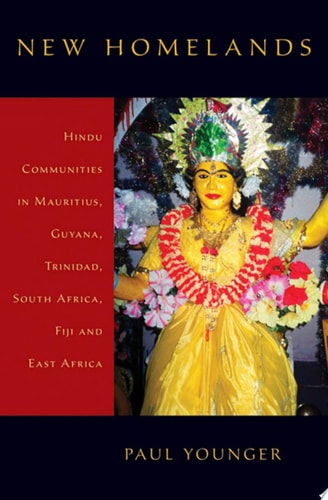
New Homelands: Hindu Communities in Mauritius, Guyana, Trinidad, South Africa, Fiji, and East Africa
0
0
As an Amazon Associate and affiliate partner, Menrva Books earns from qualifying purchases. Learn more
Author Description
When the colonial slave trade, and then slavery itself, were abolished early in the 19th century, the British empire brazenly set up a new system of trade using Indian rather than African laborers. The new system of "indentured" labor was supposed to be different from slavery because the indenture, or contract, was written for an initial period of five years and involved fixed wages and some specified conditions of work. From the workers' point of view, the one redeeming feature of the system was that most of their workmates spoke their language and came from the same area of India. Because this allowed them to develop some sense of community, by the end of the initial five years most of the Indian laborers chose to stay in the land to which they had been taken. In time that land became the place in which they joined with others to build a new homeland. In this fieldwork-based study, Paul Younger looks at the present day descendents of these workers and their post-indenture societies in Mauritius, Guyana, Trinidad, South Africa, Fiji, and East Africa. He finds that they still cling to the fact that it was an arbitrary British decision that took them there and made the society pluralistic. This plurality seems to require them to search their memory for a distinctive religious tradition that they can pass on to their children. They know that there was a loss of culture involved in their move to these locations and consider it important to recover from that loss. But they are also intensely proud of their new identity, and insist that they have established a new religious tradition in their new homeland. For generations, says Younger, these people had struggled in their situation and now they had come up with a sense of community and purpose and were prepared to make the historical claim that they had developed an appropriate religious tradition for their specific community.
Menrva's Summary
THE THESIS
This study investigates how the descendants of Indian indentured laborers in various British colonial territories have constructed and maintained distinctive religious identities within pluralistic societies. Paul Younger, a scholar of religious studies, utilizes extensive fieldwork and ethnographic observation to analyze how these communities navigate the tension between the loss of ancestral culture and the creation of new, localized religious traditions. The work argues that these groups have successfully transformed their historical displacement into a foundation for a unique, self-defined communal identity.
THE SCOPE MAP
What You Will Find
- Comparative analysis of Hindu communities in Mauritius, Guyana, Trinidad, South Africa, Fiji, and East Africa.
- Examination of the transition from indentured labor systems to established post-colonial social structures.
- Qualitative data gathered through direct fieldwork and interviews with contemporary descendants.
Scope Limits
- The study does not provide a comprehensive economic history of the British indentured labor system.
- It does not cover the entirety of the Indian diaspora, focusing specifically on the six identified regions.
THE AUTHORITY PERSPECTIVE
Scholars in the field of diaspora studies recognize this work as a significant contribution to understanding the religious evolution of the Indian diaspora. Readers frequently note the accessible yet rigorous nature of the ethnographic research provided by the author.
Page Count:
304
Publication Date:
2009-01-01
Publisher:
Oxford University Press
ISBN-10:
0190452986
ISBN-13:
9780190452988
History
Religion
Anthropology
East Indians
Sociology
Community Tags
Similar Books