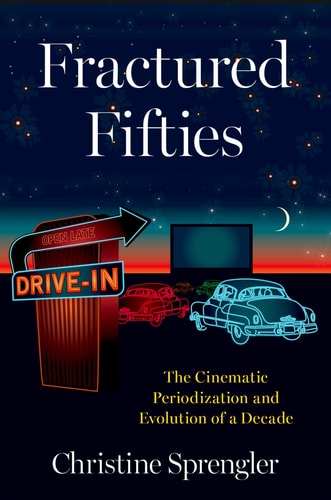
Fractured Fifties: The Cinematic Periodization and Evolution of a Decade
0
0
As an Amazon Associate and affiliate partner, Menrva Books earns from qualifying purchases. Learn more
Author Description
The 1950s as a cultural concept has surged with astonishing force over the last half century. Cultural and political investment in the postwar era has been heavily determined by the desires, anxieties, ideologies, and technologies of the contexts in which they surface. In this book author Christine Sprengler explores how contextualizing factors shaped the 1950s in different ways, and how cinematic representations spearheaded, challenged, or intervened in our cultural memories of the era.Fractured Fifties: The Cinematic Periodization and Evolution of a Decade presents a two-pronged argument― that cinema helped define the 1950s by contributing in considerable and meaningful ways to the process of periodization and subsequently a common conception of the decade, and that cinema itself has fractured our understanding of the 1950s. Fractured Fifties challenges a reductive and fairly cohesive set of tropes with a complex amalgam of representations that also intervene in debates about historiography, historicity, cultural memory, mediation, nostalgia, and periodization. Ultimately, Sprengler posits that cinema has complicated our sense of the 1950s, yielding in the process a series of 1950s types or kinds, (e.g., The Leave it to Beaver Fifties, The Jukebox Fifties, and The Cold War Fifties, The Retromediated Fifties) as well as a wealth of critical insights into myriad pasts, presents, and the evolving relationships between them.
Menrva's Summary
THE THESIS
How does cinema function as a primary mechanism for the periodization and cultural construction of the 1950s? Christine Sprengler, a scholar of film and cultural memory, examines the postwar era not as a static historical block, but as a fluid construct shaped by subsequent decades. By analyzing a diverse range of cinematic representations, she argues that film has simultaneously solidified and fractured our collective understanding of the decade, creating competing versions of the era that reflect the specific anxieties and ideologies of the times in which those films were produced.
THE SCOPE MAP
What You Will Find
- Analysis of cinematic tropes including the 'Leave it to Beaver' and 'Jukebox' archetypes.
- Theoretical framework for understanding periodization and cultural memory.
- Examination of the relationship between historical reality and mediated nostalgia.
Scope Limits
- The book does not provide a comprehensive chronological history of 1950s political events.
- It does not attempt to define a single, objective truth of the decade, focusing instead on the evolution of its representation.
THE AUTHORITY PERSPECTIVE
Scholars in film studies and historiography recognize this work as a significant contribution to the study of how popular media shapes historical consciousness. Readers frequently note the academic density of the prose, which serves as a rigorous examination of the intersection between cinema and cultural memory.
Page Count:
272
Publication Date:
2023-03-24
Publisher:
Oxford University Press
ISBN-10:
0190067357
ISBN-13:
9780190067359
Politics
History
20th Century
Humor & Entertainment
Movies
Social History
Film Studies
General
Anthropology
Historiography
Cultural History
Cultural
Media Studies
Anthropology - Cultural
Cinema History
World
New Used & Rental Textbooks
Community Tags
Similar Books