Ethics as Foreign Policy: Britain, the EU and the Other
0
0
As an Amazon Associate and affiliate partner, Menrva Books earns from qualifying purchases. Learn more
Author Description
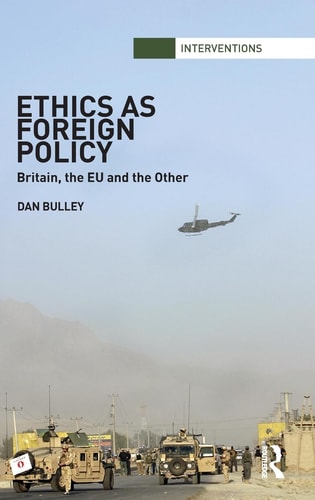
Ethical foreign policy has often been considered utopian, unrealistic and potentially very dangerous. Dan Bulley argues for a reconceptualisation of ethics as foreign policy, as both look to how we can, and ought to, relate to others. Inspired by the deconstructive thought of Jacques Derrida, Bulley studies the ethical claims of British (1997-2007) and EU (1999-2004) foreign policy. These claims are read against themselves to illustrate their deep ambiguity. A textual analysis of speeches, statements and interviews given by foreign policy makers shows that a responsibility to save âe~Africaâe(tm), to protect Iraqis, and to hospitably welcome the Balkans into the EU are also irresponsible, inhospitable and unethical. The author contends that foreign policies making a claim to morality are ethical and unethical, in their own terms, suggesting that while a truly ethical foreign policy remains ultimately unachievable, it does not justify abandoning a responsible relation to others. Rather, a negotiation of ethics as foreign policy suggests potential individual, context-bound decisions which remain open to contestation and permanent critique. Bulley argues that the goal of ethical foreign policy must be maintained as a productive hope of what is neither completely impossible, nor entirely possible.
Menrva's Summary
THE THESIS
The book investigates the inherent ambiguity and paradoxical nature of ethical claims within foreign policy. Dan Bulley examines the ethical foreign policies of Britain (1997-2007) and the EU (1999-2004), drawing on the deconstructive philosophy of Jacques Derrida. Through textual analysis of speeches and statements, the author demonstrates how policies framed as ethical, such as saving Africa, protecting Iraqis, or welcoming the Balkans, are simultaneously revealed as irresponsible and unethical within their own terms. Bulley argues that while a perfectly ethical foreign policy is unattainable, this does not negate the necessity of maintaining a responsible relationship with others, advocating for context-bound decisions open to critique.
THE SCOPE MAP
- Analysis of British foreign policy ethical claims (1997-2007).
- Examination of EU foreign policy ethical claims (1999-2004).
- Application of Jacques Derrida's deconstructive thought to foreign policy.
- Textual analysis of speeches, statements, and interviews by foreign policy makers.
- Critique of the ethical and unethical dimensions of policies towards Africa, Iraq, and the Balkans.
- Argument for a reconceptualization of ethics as foreign policy.
- Discussion on the achievability and necessity of ethical foreign policy.
- Exploration of individual, context-bound decisions that remain open to contestation.
THE AUTHORITY PERSPECTIVE
The book offers a critical examination of ethical foreign policy, using deconstructive philosophy to highlight its inherent ambiguities. It suggests that policies presented as moral often contain contradictory elements, making a truly ethical foreign policy an elusive goal. The work advocates for a continued pursuit of responsible relations with others, emphasizing the importance of context-specific decisions that are subject to ongoing critique. This approach positions ethical foreign policy not as a fully achievable state, but as a productive hope that guides action.
Page Count:
174
Publication Date:
2009-01-01
Publisher:
Routledge
ISBN-10:
0415483611
ISBN-13:
9780415483612
Philosophy
Politics
Non-Fiction
Political Philosophy
International relations
British Politics
Community Tags
Similar Books