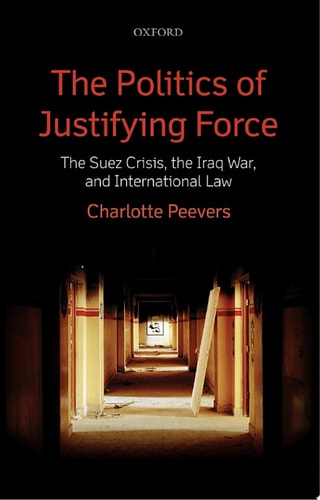
The Politics of Justifying Force: The Suez Crisis, the Iraq War, and International Law
0
0
As an Amazon Associate and affiliate partner, Menrva Books earns from qualifying purchases. Learn more
Author Description
What are the politics involved in a government justifying its use of military force abroad? What is the role of international law in that discourse? How and why is international law crucial to this process? And what role does the media have in mediating the interaction of international law and politics? This book provides a fresh and engaging answer to these questions. It introduces different actors to the study of international law in this context, in particular highlighting the importance of institutional actors and the role of the media. It takes a theoretical approach, informed by detailed empirical analysis of key case studies, which challenges the traditional distinction between the spheres of 'the international' and 'the domestic' in global affairs, and the role of international law in the making of public policy. The book specifically critiques the idea of the 'politics of justification', which argues that deploying international legal norms to justify governmental decisions resulting in the use of force necessarily constrains government actions, and leads to fewer instances of military intervention. The politics of justification, on this account, can be seen as a progressive practice, through which international law can become embedded in domestic societies. The book investigates the actors engaged in this justification, and the institutional contexts within which legal justification is articulated, interpreted, and contested. It provides a rich, detailed account of domestic British discourse in the crucial case studies of the Suez Crisis of 1956 and the Iraq War of 2003, making extensive use of archival material, newspaper and television reporting, Parliamentary debates, polling data, personal memoirs, and the declassified material provided to several Public Inquiries, including the Chilcot Inquiry. In light of these sources, it considers the concept of international law as a language and form of communication rather than a set of abstract norms. It argues
Menrva's Summary
THE THESIS
This book investigates the political mechanisms governments employ to justify the use of military force and the specific role international law plays within that communicative process. Charlotte Peevers, a scholar in international law and politics, utilizes a theoretical framework to challenge the assumption that legal justification inherently constrains state aggression. By examining the intersection of domestic discourse and international norms, she argues that international law functions more as a language of political communication than as a static set of regulatory constraints.
THE SCOPE MAP
What You Will Find
- Comparative analysis of the 1956 Suez Crisis and the 2003 Iraq War.
- Examination of institutional actors, including government bodies and the media, in shaping public policy.
- Analysis of archival materials, Parliamentary debates, polling data, and declassified documents from the Chilcot Inquiry.
Scope Limits
- The analysis is primarily focused on British domestic discourse and does not provide a comprehensive global survey of international legal applications.
- The text does not attempt to provide a universal legal theory but rather focuses on the specific political utility of legal rhetoric.
THE AUTHORITY PERSPECTIVE
Scholars and political analysts recognize this work as a rigorous examination of the intersection between legal rhetoric and state power. Readers frequently note the academic density of the prose, which serves as a significant contribution to the study of how international law is operationalized in domestic political spheres.
Page Count:
288
Publication Date:
2013-01-01
Publisher:
OUP Oxford
ISBN-10:
0191510548
ISBN-13:
9780191510540
International Law
Military History
Professional Career & Trade
Foreign Policy
International relations
British Politics
Community Tags
Similar Books