Symphony No. 9: Study Score
0
0
As an Amazon Associate and affiliate partner, Menrva Books earns from qualifying purchases. Learn more
Author Description
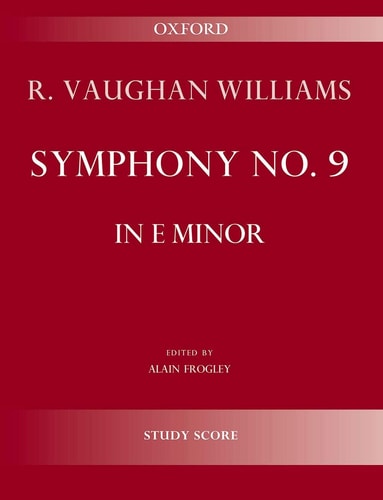
The Symphony No. 9 in E minor, the last symphony by Vaughan Williams, was completed in 1957 and first performed by the Royal Philharmonic conducted by Malcolm Sargent on 2 April 1958, in the composer's eighty-sixth year. Vaughan Williams's original idea was to create a programmatic symphony based on Tess of the d'Urbervilles, even though the programmatic elements eventually disappeared. Existing sketches clearly indicate that in the early stages of composition certain passages related to specific people and events in the novel: in some manuscripts the first movement is headed Wessex Prelude and the heading Tess appears above sketches for the second movement. The work is in four movements: Moderato Maestoso; Andante sostenuto; Scherzo: Allegro pesante; Finale: Andante tranquillo. It is worth noting that the opening theme of the slow movement comes from music composed more than fifty years earlier: A Sea Symphony and an even earlier, unpublished tone poem from 1904 called The Solent. The composer himself called the drumbeat that immediately follows “the ghostly drummer of Salisbury Plain.” In the composer’s note accompanying the premiere he writes: “The usual symphony orchestra is used with the addition of three saxophones and flugelhorn. This beautiful and neglected instrument is not usually allowed in the refined circles of the orchestra and has been banished to the brass band, where it is allowed to indulge in the art of vibrato, while in the orchestra it is obliged to play with a pure and unwavering tone. The saxophones, also, are not expected, except possibly in one place in the scherzo, to behave like demented cats, but are allowed to be their own romantic selves. Otherwise the orchestra is normal and is, the composer hopes, sound in wind and strings.” Very early in the first movement the saxophones play a chorale-like passage, perhaps to emphasize that this will not be the sort of dance band music which appears in the Sixth Symphony.
Menrva's Summary
THE THESIS
This study score provides a comprehensive look at the final symphonic work of Ralph Vaughan Williams, examining the structural and thematic evolution of his Symphony No. 9 in E minor. The author, a seminal figure in 20th-century British music, utilizes this score to document the transition from his initial programmatic intentions based on Thomas Hardy’s literature to the final abstract musical form. The text serves as a primary resource for understanding the composer's late-career orchestration choices, including the unconventional integration of saxophones and flugelhorn within a traditional symphonic framework.
THE SCOPE MAP
What You Will Find
- Detailed analysis of the four-movement structure: Moderato Maestoso, Andante sostenuto, Scherzo, and Finale.
- Historical context regarding the composer's transition from programmatic concepts to absolute music.
- Technical notes on the inclusion of non-traditional orchestral instruments like the flugelhorn and saxophones.
- Insights into the reuse of thematic material from earlier works such as A Sea Symphony and The Solent.
THE AUTHORITY PERSPECTIVE
Musicologists and conductors frequently cite this study score as a vital resource for understanding the late-period stylistic shifts of Vaughan Williams. Experts highlight the text for its clarity in explaining the composer's specific intent behind the unique instrumentation choices found in the work.
Page Count:
172
Publication Date:
1969-03-31
Publisher:
Oxford University Press
ISBN-10:
0193694352
ISBN-13:
9780193694354
Music
Biography
Symphonies
Music theory
Scores
Community Tags
Similar Books