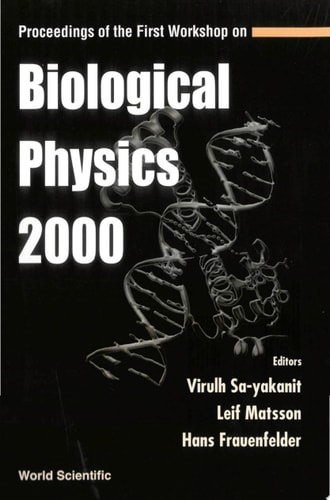
Proceedings of the First Workshop on Biological Physics 2000 Chulalongkorn University, Bangkok, Thailand, September 18-22, 2000
0
0
As an Amazon Associate and affiliate partner, Menrva Books earns from qualifying purchases. Learn more
Author Description
Like inanimate matter, biological matter is condensed, though it may be more complex. However, a living cell is a chemically open system with biological functions that are often a nonstationary, nonlinear type of collective phenomena driven by chemical reactants, e.g. ATP, GTP, ligands and receptors. The living cell and many of its subsystems are hence lyotropic systems, depending on various reactant concentrations rather than the temperature. Nonlocal and local correlations of the interacting molecules become the prerequisites for signal transduction.This book constitutes the proceedings of the workshop entitled?Biological Physics 2000?.
Menrva's Summary
THE THESIS
This volume explores the complex, condensed nature of biological matter and its unique properties as an open, chemically driven system. The book delves into how living cells, unlike inanimate matter, function as lyotropic systems dependent on reactant concentrations and exhibit nonlinear collective phenomena. It highlights the critical role of nonlocal and local correlations in molecular interactions for signal transduction, presenting findings from the 'Biological Physics 2000' workshop.
THE SCOPE MAP
- Discussions on biological matter as a complex, condensed system.
- Analysis of living cells as chemically open systems with nonlinear dynamics.
- Exploration of lyotropic system properties dependent on reactant concentrations.
- Examination of nonlocal and local correlations in molecular interactions.
- Insights into signal transduction mechanisms within biological systems.
- Proceedings from the 'Biological Physics 2000' workshop.
THE AUTHORITY PERSPECTIVE
The proceedings from the 'Biological Physics 2000' workshop offer a specialized look into the interdisciplinary field of biological physics. The content focuses on the fundamental principles governing biological systems, particularly their chemical and physical dynamics. The collection likely appeals to researchers and advanced students seeking to understand the complex interactions at the molecular level within living organisms. The emphasis on nonlinear dynamics and lyotropic properties suggests a rigorous, data-driven approach to biological phenomena.
Page Count:
338
Publication Date:
2001-01-01
Publisher:
World Scientific
ISBN-10:
9810246226
ISBN-13:
9789810246228
Non-Fiction
Science
Biology
Conferences
Physics
Community Tags
Similar Books