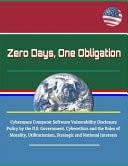
Zero Days, One Obligation: Cyberspace Computer Software Vulnerability Disclosure Policy by the U. S. Government, Cyberethics and the Roles of Morality, Utilitarianism, Strategic and National Interests
0
0
As an Amazon Associate and affiliate partner, Menrva Books earns from qualifying purchases. Learn more
Author Description
This study set out to apply the moral principle of utilitarianism to the policy problem associated with zero-day vulnerabilities. These vulnerabilities can be understood as errors in coding that are potentially exploitable and unknown to either the creators or users of the software. If attack vectors related to zero-day vulnerabilities are completely dependent upon correctable coding errors, what should policy require when the U.S. government detects a zero-day vulnerability? Should it be disclosed publicly so it can be patched or restrict knowledge of it so it can be weaponized? This study applied revisionist John Stuart Mill's unique and nuanced description of utilitarianism to the Vulnerabilities and Equities Policy and Process (VEP) to evaluate what aspects of the policy fulfilled Mill's moral code and what areas could be improved. The improvement recommendation is made on strictly moral terms. This study acknowledges while moral policy has undeniable benefits, there are times where the moral can come at the expense of the strategic, and national interests can be compromised. Ultimately, much like the VEP, this study recommends balance.This compilation includes a reproduction of the 2019 Worldwide Threat Assessment of the U.S. Intelligence Community.There is a debate surrounding zero-day vulnerabilities and the exploits associated with them. A variety of attack vectors exist in cyberspace: spearfishing exploits human gullibility through email, brute force techniques like Distributed Denial of Service (DDoS) can overwhelm servers, and some less technical approaches simply take advantage of predictable or lackadaisical security practices. The attack vector, ominously referred to as a zero-day weapon, is something different. Zero-days weapons are not inherently violent, rather they represent the exploitation of an error in a program's coding. The error in coding is the vulnerability. Research scientists at RAND in their The Defender's Dilemma defined zero-days as,
Menrva's Summary
THE THESIS
This study applies the moral principle of utilitarianism to the policy problem of zero-day vulnerabilities in cyberspace. The core question is whether the U.S. government should disclose detected zero-day vulnerabilities for patching or withhold knowledge for strategic advantage. The research evaluates the Vulnerabilities and Equities Policy and Process (VEP) against John Stuart Mill's utilitarianism, identifying areas for improvement based on moral terms. It acknowledges the potential conflict between moral policy and national interests, ultimately recommending a balance.
THE SCOPE MAP
- Analysis of zero-day vulnerabilities as coding errors exploitable by unknown attack vectors.
- Application of John Stuart Mill's utilitarianism to U.S. government cybersecurity policy.
- Evaluation of the Vulnerabilities and Equities Policy and Process (VEP).
- Moral critique of policy decisions regarding disclosure versus weaponization of vulnerabilities.
- Discussion of the tension between moral imperatives and national security interests.
- Recommendation for a balanced approach to zero-day vulnerability management.
- Inclusion of the 2019 Worldwide Threat Assessment of the U.S. Intelligence Community.
THE AUTHORITY PERSPECTIVE
This work critically examines the ethical dimensions of U.S. government policy concerning zero-day vulnerabilities, framing the debate through the lens of utilitarianism. The analysis focuses on the moral implications of disclosure versus strategic withholding of exploit knowledge. It assesses the existing Vulnerabilities and Equities Policy and Process (VEP) against the moral framework of John Stuart Mill, proposing improvements based on ethical considerations. While acknowledging the potential for moral policy to conflict with national interests, the study advocates for a balanced approach, recognizing the complex interplay between ethics and security in cyberspace.
Page Count:
88
Publication Date:
2019-06-22
Publisher:
Amazon Digital Services LLC - KDP Print US
ISBN-10:
1075599660
ISBN-13:
9781075599668
Non-Fiction
Philosophy
Politics
National security
Ethics
Government Policy
Cybersecurity
Community Tags
Similar Books









Reader Comments
Share Your Thoughts
No comments yet. Be the first to share your thoughts!