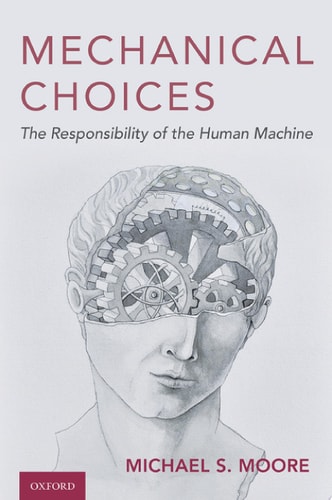
Mechanical Choices: The Responsibility of the Human Machine
0
0
As an Amazon Associate and affiliate partner, Menrva Books earns from qualifying purchases. Learn more
Author Description
Mechanical Choices details the intimate connection that exists between morality and law: the morality we use to blame others for their misdeeds and the criminal law that punishes them for these misdeeds. This book shows how both law and morality presuppose the accuracy of common sense, a centuries-old psychology that defines people as rational agents who make honorable choices and act for just reasons. It then shows how neuroscience is commonly taken to challenge these fundamental psychological assumptions. Such challenges--four in number--are distinguished from each other by the different neuroscientific facts from which they arise: the fact that human choices are caused by brain events; the fact that those choices don't cause the actions that are their objects but are only epiphenomenal to those choices; the fact that those choices are identical to certain physical events in the brain; and the fact that human subjects are quite fallible in their knowledge of what they are doing and why. The body of this book shows how such challenges are either based on faulty facts or misconceived as to the relevance of such facts to responsibility. The book ends with a detailed examination of the neuroscience of addiction, an examination which illustrates how neuroscience can help rather than challenge both law and morality in their quest to accurately define excuses from responsibility.
Menrva's Summary
THE THESIS
This book investigates whether neuroscientific advancements fundamentally undermine the legal and moral frameworks that hold individuals accountable for their actions. Michael S. Moore, a scholar of law and philosophy, examines the intersection of common sense psychology and modern brain science. He argues that current legal systems rely on a model of rational agency that neuroscience is often incorrectly interpreted as invalidating. By dissecting four specific neuroscientific challenges to human agency, the author seeks to reconcile biological findings with the necessity of moral and legal responsibility.
THE SCOPE MAP
What You Will Find
- Analysis of four distinct neuroscientific challenges to human agency
- Philosophical critique of the relationship between brain events and intentional action
- Examination of the legal concept of excuses in criminal law
- Case study on the neuroscience of addiction
Scope Limits
- Does not provide a comprehensive history of neuroscience
- Does not offer a manual for clinical psychiatric practice
THE AUTHORITY PERSPECTIVE
Experts recognize this work as a rigorous philosophical engagement with the intersection of jurisprudence and cognitive science. Readers frequently note the academic density of the prose, which requires a strong background in legal theory or philosophy to fully navigate.
Page Count:
611
Publication Date:
2020-01-01
Publisher:
Oxford University Press
ISBN-10:
019086401X
ISBN-13:
9780190864019
Psychology
Philosophy
Law
Neuroscience
Ethics
Professional Career & Trade
Community Tags
Similar Books