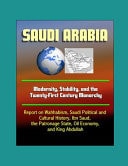
Saudi Arabia: Modernity, Stability, and the Twenty-First Century Monarchy - Report on Wahhabism, Saudi Political and Cultural History, Ibn Saud, the Patronage State, Oil Economy, and King Abdullah
0
0
As an Amazon Associate and affiliate partner, Menrva Books earns from qualifying purchases. Learn more
Author Description
This work will be of interest to any reader seeking a better understanding of the political and cultural history in Saudi Arabia. There is a current need for Special Operations Forces, specifically to appreciate the historical, domestic, regional, and other influences on the worldview and decision-making of Saudi Arabia's leaders, particularly those issues that have a significant impact on U.S.-Saudi security relationships. His monograph is a fascinating, condensed history of Saudi Arabia, focused on events and decisions that influence the modern political worldview of citizens in that country. For example, a history of tribes being ruled by outsiders; the pros and cons of alliances with the British and (more recently) the U.S., the impact of global geopolitics (e.g. Cold War), and the impact of regional neighbors' policies and events on Saudi Arabia's domestic and foreign policies (to include its relationship with the U.S.). This volume explains the importance of politically shrewd and pragmatic leaders and the ways that Iran's ambitions and policies threaten Saudi Arabia's regional influence, as well as how the historical fracturing of the U.S.-Iran relationship played well for Saudi Arabia. This book also provides a brief overview of Arabia from the early Islamic period to the rise of the first Saudi state in 1744 and then examines the emergence of Wahhabi Islam and First (1744-1818) and Second (1824-1891) Saudi States and the challenges associated with them. He then analyzes the emergence of the Third Saudi State and Saudi Arabia, and the recognition by Ibn Saud of the weaknesses and problems that undermined the previous Saudi States. This leads to the great succession crisis of the 1950s and 1960s when revolutionary Egypt and instability across the region toppled monarchies and threatened traditional regimes. Dr. Barrett highlights contemporary Saudi Arabia from 1975 to 2005 (the year that King Abdullah assumed the throne) and analyzes the reign of King Abdulla
Menrva's Summary
THE THESIS
This report investigates the complex interplay of modernity, stability, and the evolving nature of the Saudi monarchy in the 21st century. The work, authored by entities within the U.S. Department of Defense and Joint Special Operations University, aims to provide Special Operations Forces with a comprehensive understanding of Saudi Arabia's historical, domestic, and regional influences on leadership decision-making, particularly as they impact U.S.-Saudi security relations. It traces the nation's political and cultural history from the early Islamic period through the establishment of the three Saudi states, the rise of Wahhabism, and the consolidation of power under Ibn Saud, culminating in an analysis of contemporary Saudi Arabia from 1975 to 2005.
THE SCOPE MAP
- A historical overview from the early Islamic period to the rise of the first Saudi state in 1744.
- An examination of the emergence of Wahhabi Islam and the First and Second Saudi States.
- Analysis of the challenges that undermined previous Saudi states and the emergence of the Third Saudi State.
- Discussion of the impact of global geopolitics, regional neighbors' policies, and the Cold War on Saudi Arabia.
- An overview of the importance of politically shrewd leaders and the threats posed by Iran's regional ambitions.
- A focus on contemporary Saudi Arabia from 1975 to 2005, analyzing the reign of King Abdullah.
- Exploration of the oil economy and its influence on the patronage state.
THE AUTHORITY PERSPECTIVE
This report is designed as an analytical tool for U.S. Special Operations Forces, focusing on the historical, domestic, and regional influences shaping Saudi leadership and impacting U.S.-Saudi security relationships. The work synthesizes a condensed history of Saudi Arabia, detailing events and decisions that inform the modern political worldview of its citizens and leaders. It examines the country's strategic alliances, the effects of global and regional geopolitics, and the historical development of the Saudi state and its relationship with Wahhabi Islam. The report's detailed historical scope, from the early Islamic period to contemporary issues, provides a foundational understanding for assessing current and future political and security dynamics.
Page Count:
97
Publication Date:
2017-09-14
Publisher:
Amazon Digital Services LLC - KDP Print US
ISBN-10:
1549747436
ISBN-13:
9781549747434
Politics
History
Non-Fiction
Saudi Arabia
Monarchy
Community Tags
Similar Books










Reader Comments
Share Your Thoughts
No comments yet. Be the first to share your thoughts!