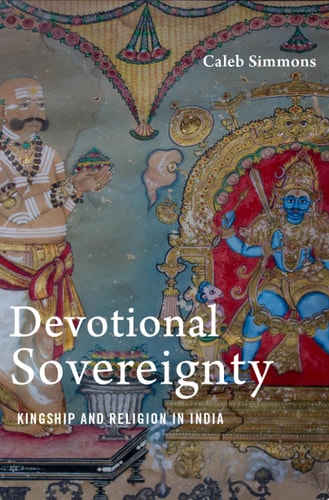
Devotional Sovereignty: Kingship and Religion in India
0
0
As an Amazon Associate and affiliate partner, Menrva Books earns from qualifying purchases. Learn more
Author Description
Devotional Sovereignty: Kingship and Religion in India investigates the shifting conceptualization of sovereignty in the South Indian kingdom of Mysore during the reigns of Tipu Sultan (r. 1782-1799) and Krishnaraja Wodeyar III (r. 1799-1868). Tipu Sultan was a Muslim king famous for resisting British dominance until his death; Krishnaraja III was a Hindu king who succumbed to British political and administrative control. Despite their differences, the courts of both kings dealt with the changing political landscape by turning to the religious and mythical past to construct a royal identity for their kings. Caleb Simmons explores the ways in which these two kings and their courts modified and adapted pre-modern Indian notions of sovereignty and kingship in reaction to British intervention. The religious past provided an idiom through which the Mysore courts could articulate their rulers' claims to kingship in the region, attributing their rule to divine election and employing religious vocabulary in a variety of courtly genres and media. Through critical inquiry into the transitional early colonial period, this study sheds new light on pre-modern and modern India, with implications for our understanding of contemporary politics. It offers a revisionist history of the accepted narrative in which Tipu Sultan is viewed as a radical Muslim reformer and Krishnaraja III as a powerless British puppet. Simmons paints a picture of both rulers in which they work within and from the same understanding of kingship, utilizing devotion to Hindu gods, goddesses, and gurus to perform the duties of the king.
Menrva's Summary
THE THESIS
This book investigates how the South Indian kingdom of Mysore navigated the transition to British colonial rule by reinterpreting traditional concepts of sovereignty through religious and mythical frameworks. Caleb Simmons, a scholar of South Asian religions, examines the reigns of Tipu Sultan and Krishnaraja Wodeyar III to challenge binary narratives of their rule. By analyzing courtly documents, literature, and iconography, Simmons argues that both monarchs utilized a shared idiom of devotional sovereignty to legitimize their authority against the backdrop of encroaching British power.
THE SCOPE MAP
What You Will Find
- Analysis of the political and religious transition in Mysore from 1782 to 1868.
- Examination of courtly media, including inscriptions, poetry, and ritual practices.
- A comparative study of a Muslim ruler and a Hindu ruler operating under similar colonial pressures.
Scope Limits
- The study focuses specifically on the Mysore region and does not provide a comprehensive history of all Indian princely states.
- The analysis is limited to the late eighteenth and nineteenth centuries, excluding earlier or later periods of Mysore history.
THE AUTHORITY PERSPECTIVE
Scholars in the field of South Asian history recognize this work as a significant revisionist contribution that complicates the traditional historiography of Tipu Sultan and Krishnaraja Wodeyar III. Readers frequently note the academic density of the prose, which is well-suited for researchers and students of colonial Indian history and religious studies.
Page Count:
290
Publication Date:
2019-01-01
Publisher:
Oxford University Press
ISBN-10:
0190088915
ISBN-13:
9780190088910
Religion
History
Subjects & Themes
Asian Studies
Colonialism
Humanities
Monarchy
Community Tags
Other Editions(2)
Similar Books