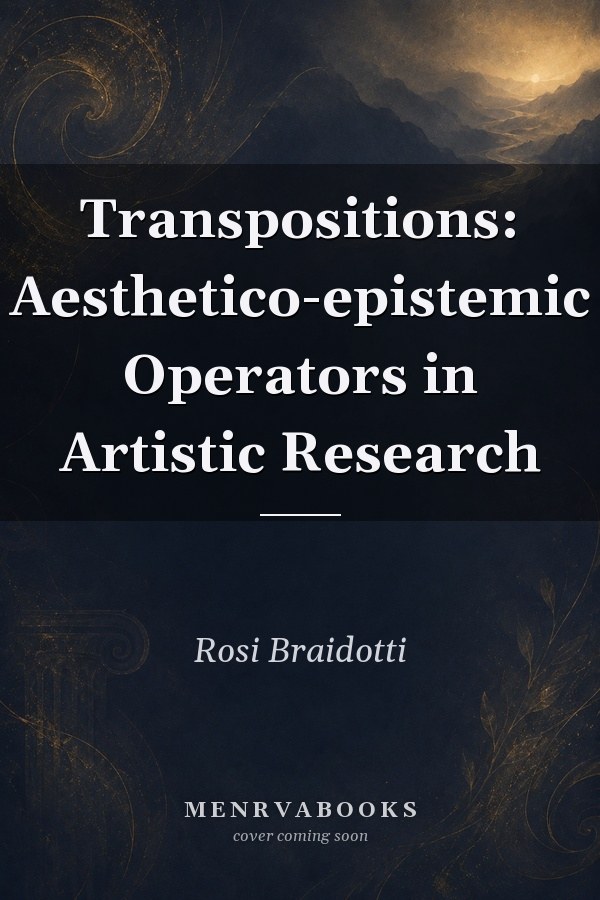
Transpositions: Aesthetico-epistemic Operators in Artistic Research
0
0
As an Amazon Associate and affiliate partner, Menrva Books earns from qualifying purchases. Learn more
Author Description
New modes of epistemic relationships in artistic research Research leads to new insights rupturing the existent fabric of knowledge. Situated in the still evolving field of artistic research, this book investigates a fundamental quality of this process. Building on the lessons of deconstruction, artistic research invents new modes of epistemic relationships that include aesthetic dimensions. Under the heading transposition, seventeen artists, musicians, and theorists explain how one thing may turn into another in a spatio-temporal play of identity and difference that has the power to expand into the unknown. By connecting materially concrete positions in a way familiar to artists, this book shows how moves can be made between established positions and completely new ground. In doing so, research changes from a process that expands knowledge to one that creatively reinvents it. Contributors: Annette Arlander (University of the Arts Helsinki), Paulo de Assis (Orpheus Institute, Ghent), Rosi Braidotti (Utrecht University), Leif Dahlberg (Royal Institute of Technology Stockholm), Lucia D?Errico (Orpheus Institute, Ghent), Mika Elo (University of the Arts Helsinki), Laura González (Royal Conservatoire of Scotland), Esa Kirkkopelto (University of the Arts Helsinki), Yve Lomax (Royal College of Art, London), Cecile Malaspina (CNRS-Universit{caron} Paris 1/Universit{caron} Paris 7), Tor-Finn Malum Fitje (independent artist, Oslo), Dieter Mersch (Zurich University of the Arts), David Pirr{dotb} (University of Music and Performing Arts Graz), Hans-Jörg Rheinberger (Max Planck Institute for the History of Science, Berlin), Hanns Holger Rutz (University of Music and Performing Arts Graz), Michael Schwab (Orpheus Institute, Ghent/University of Applied Arts Vienna), Birk Weiberg (Zurich University of the Arts)
Menrva's Summary
THE THESIS
This book investigates how artistic research generates new knowledge through the concept of transposition. It explores the fundamental quality of artistic research, which involves creating new epistemic relationships that incorporate aesthetic dimensions, building on deconstructivist thought. Seventeen artists, musicians, and theorists contribute by explaining how one element can transform into another within a dynamic interplay of identity and difference, pushing into the unknown. The work demonstrates how established positions can be shifted to entirely new ground, thereby transforming research from a knowledge-expanding process into one that creatively reinvents knowledge.
THE SCOPE MAP
- Exploration of new modes of epistemic relationships in artistic research.
- Focus on the concept of 'transposition' as a mechanism for knowledge creation.
- Contributions from seventeen artists, musicians, and theorists.
- Analysis of how one thing may turn into another in a spatio-temporal play of identity and difference.
- Demonstration of how artistic research can expand into the unknown.
- Connection of materially concrete positions familiar to artists.
- Examination of moves between established positions and new ground.
- Argument that research can creatively reinvent knowledge rather than just expand it.
THE AUTHORITY PERSPECTIVE
The book is presented as a significant contribution to the evolving field of artistic research, offering a novel framework for understanding knowledge creation within this domain. Its contributors, a diverse group of artists and theorists, provide practical and theoretical insights into the process of transposition. The work is positioned to appeal to those interested in the intersection of art, epistemology, and research methodologies. The collection aims to demonstrate how artistic practice can fundamentally alter the nature of inquiry.
Page Count:
324
Publication Date:
2018-01-01
Publisher:
Leuven University Press
ISBN-10:
946166253X
ISBN-13:
9789461662538
Philosophy
Art
Non-Fiction
Research
Epistemology
Community Tags
Similar Books
Reader Comments
Share Your Thoughts
No comments yet. Be the first to share your thoughts!