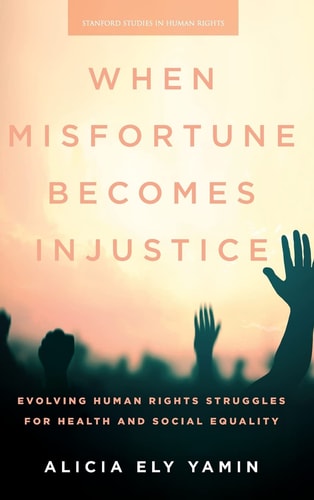
When Misfortune Becomes Injustice: Evolving Human Rights Struggles for Health and Social Equality
0
0
As an Amazon Associate and affiliate partner, Menrva Books earns from qualifying purchases. Learn more
Author Description
When Misfortune Becomes Injustice surveys the progress and challenges in deploying human rights to advance health and social equality over recent decades. Alicia Ely Yamin weaves together theory and firsthand experience in a compelling narrative of how evolving legal norms, empirical knowledge, and development paradigms have interacted in the realization of health rights, and challenges us to consider why these advances have failed to produce greater equality within and between nations. In this revised and expanded second edition, Yamin incorporates crucial lessons learned about the state of global health equity and public health systems during the COVID-19 pandemic, demonstrating just how incompatible the current institutionalized world order--based on neoliberal, financialized capitalism--is with one in which the rights of diverse people around the globe can be realized. COVID-19 struck a world that had been shaped by decades of disinvestment in public health, health systems, and social protection, as well as privatization of wealth and gaping social inequalities within and between countries, and the evident crisis of confidence in the capacity of democratic political institutions and global governance was deepened by the pandemic. Yamin argues that transformative human rights praxis in health calls for addressing issues of structural inequality and political economy, and working across disciplinary silos through networks and social movements.
Menrva's Summary
THE THESIS
This book investigates the complex interplay between human rights, health, and social equality, examining how evolving legal and development paradigms have both advanced and failed to fully realize these rights. Alicia Ely Yamin, drawing on extensive theory and firsthand experience, analyzes the progress and persistent challenges in using human rights frameworks to achieve health and social equality. The work critically assesses why, despite advancements, significant inequalities persist both within and between nations. The second edition specifically incorporates lessons from the COVID-19 pandemic, highlighting the incompatibility of current global economic structures with equitable rights realization and advocating for a praxis that addresses structural inequality and political economy through collective action.
THE SCOPE MAP
- Analysis of the evolution of human rights struggles for health and social equality over recent decades.
- Exploration of the interaction between legal norms, empirical knowledge, and development paradigms in realizing health rights.
- Critique of why advances in health rights have not led to greater equality within and between nations.
- Inclusion of lessons learned from the COVID-19 pandemic regarding global health equity and public health systems.
- Argument regarding the incompatibility of neoliberal, financialized capitalism with the realization of global human rights.
- Discussion of the impact of decades of disinvestment in public health, health systems, and social protection.
- Advocacy for transformative human rights praxis in health that addresses structural inequality and political economy.
- Emphasis on working across disciplinary silos through networks and social movements.
THE AUTHORITY PERSPECTIVE
The book is regarded as a critical examination of the practical application of human rights to health and social equality, particularly in light of recent global events. It is noted for weaving together theoretical insights with practical experience to dissect the successes and failures in achieving greater equity. The revised edition's incorporation of COVID-19's impact is seen as crucial for understanding contemporary challenges to global health systems and the existing world order. The author's call for a human rights praxis that confronts structural inequalities and economic systems is a central theme.
Page Count:
326
Publication Date:
2023-01-01
Publisher:
Stanford University Press
ISBN-10:
1503635945
ISBN-13:
9781503635944
Politics
Economics
Non-Fiction
Health
Human rights
Public Health
Global Health
Social justice
Community Tags
Other Editions(2)
Similar Books