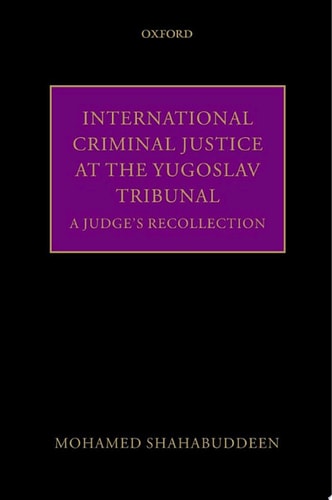
International Criminal Justice at the Yugoslav Tribunal: A Judge's Recollection
0
0
As an Amazon Associate and affiliate partner, Menrva Books earns from qualifying purchases. Learn more
Author Description
International criminal justice has undergone rapid recent development. Since the establishment of the International Criminal Tribunal for the former Yugoslavia (ICTY) in 1993, and the International Criminal Tribunal for Rwanda (ICTR) in the following year, the field has changed beyond recognition. The traditional immunity of presidents or heads of government, prime ministers, and other functionaries acting in an official capacity no longer prevails; the doctrine of superior orders is inapplicable except, where appropriate, as in mitigation; and the gap between international armed conflict and non-international armed conflict has closed. More generally, the bridge has been crossed between the irresponsibility of the state and the criminal responsibility of the individual. As a result, the traditional impunity of the state has practically gone. This book, by one of the former judges of the ICTY, ICTR, and the International Court of Justice, assesses some of the workings of the ICTY that have shaped these developments. In it, Judge Shahabuddeen provides an insightful overview of the nature of this criminal court, established on behalf of the whole of the international community. He reflects on its transformation into one of the leading fora for the growth of international criminal law first-hand, offering a unique perspective on the challenges it has faced. Judge Shahabuddeen's experience in international criminal justice makes this volume essential reading for those interested in, or working with, international criminal law.
Menrva's Summary
THE THESIS
This work investigates how the International Criminal Tribunal for the former Yugoslavia (ICTY) functioned as a catalyst for the evolution of international criminal law and the erosion of state immunity. Judge Mohamed Shahabuddeen, a distinguished jurist who served on the ICTY, ICTR, and the International Court of Justice, utilizes his direct experience to analyze the legal mechanisms that shifted the focus from state responsibility to individual criminal accountability. He argues that the tribunal’s operations fundamentally altered the landscape of global justice by challenging traditional doctrines regarding head-of-state immunity and the distinction between types of armed conflict.
THE SCOPE MAP
What You Will Find
- Analysis of the legal evolution of the ICTY and ICTR
- Examination of the doctrine of superior orders and its application in international law
- First-hand reflections on the institutional challenges faced by international criminal courts
- Discussion on the transition from state impunity to individual criminal responsibility
Scope Limits
- The text focuses primarily on the ICTY and does not provide an exhaustive history of all international criminal tribunals
- It does not serve as a comprehensive textbook on international law but rather as a specialized judicial reflection
THE AUTHORITY PERSPECTIVE
Legal scholars and practitioners frequently cite this volume as a primary source for understanding the internal judicial philosophy of the ICTY. Experts highlight the text for its unique blend of personal memoir and rigorous legal analysis, noting its value for those studying the development of international criminal jurisprudence.
Page Count:
260
Publication Date:
2012-01-01
Publisher:
OUP Oxford
ISBN-10:
0191649856
ISBN-13:
9780191649851
Politics
History
Biography
Law
International Law
Human rights
Professional Career & Trade
Community Tags
Similar Books