Oxo-Biodegradation of Full Carbon Backbone Polymers: Oxidation and Biodegradation of Full Carbon Backbone Polymeric Materials Under Different Environmental Conditions
0
0
As an Amazon Associate and affiliate partner, Menrva Books earns from qualifying purchases. Learn more
Author Description
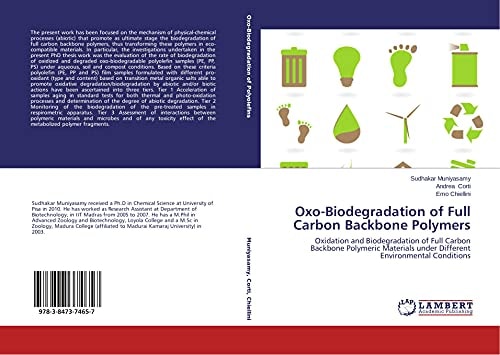
The present work has been focused on the mechanism of physical-chemical processes (abiotic) that promote as ultimate stage the biodegradation of full carbon backbone polymers, thus transforming these polymers in eco-compatible materials. In particular, the investigations undertaken in the present PhD thesis work was the evaluation of the rate of biodegradation of oxidized and degraded oxo-biodegradable polyolefin samples (PE, PP, PS) under aqueous, soil and compost conditions. Based on these criteria polyolefin (PE, PP and PS) film samples formulated with different pro-oxidant (type and content) based on transition metal organic salts able to promote oxidative degradation/biodegradation by abiotic and/or biotic actions have been ascertained into three tiers. Tier 1Acceleration of samples aging in standard tests for both thermal and photo-oxidation processes and determination of the degree of abiotic degradation. Tier 2Monitoring of the biodegradation of the pre-treated samples in respirometric apparatus. Tier 3Assessment of interactions between polymeric materials and microbes and of any toxicity effect of the metabolized polymer fragments.
Menrva's Summary
THE THESIS
This work investigates the mechanisms by which full carbon backbone polymers can be transformed into eco-compatible materials through oxidation and biodegradation. The research focuses on evaluating the biodegradation rates of oxidized and degraded oxo-biodegradable polyolefin samples (PE, PP, PS) under various environmental conditions, including aqueous, soil, and compost. Investigations were structured into three tiers: assessing abiotic degradation through thermal and photo-oxidation, monitoring biodegradation in respirometric apparatus, and evaluating microbial interactions and potential toxicity of degraded fragments.
THE SCOPE MAP
- Detailed examination of the physical-chemical processes (abiotic) driving polymer biodegradation.
- Evaluation of biodegradation rates for PE, PP, and PS polyolefin samples under aqueous, soil, and compost conditions.
- Classification of polyolefin samples into three tiers based on pro-oxidant formulation and degradation potential.
- Standardized testing for thermal and photo-oxidation acceleration and determination of abiotic degradation degree.
- Respirometric monitoring of the biodegradation of pre-treated polymer samples.
- Assessment of interactions between polymeric materials and microbes.
- Analysis of potential toxicity effects from metabolized polymer fragments.
THE AUTHORITY PERSPECTIVE
The research presented in this work offers a detailed analysis of the abiotic and biotic processes involved in the oxo-biodegradation of common polyolefins. It systematically categorizes the degradation behavior of polyethylene, polypropylene, and polystyrene based on their formulation and environmental exposure. The tiered approach, from initial oxidation to microbial interaction and toxicity assessment, provides a comprehensive framework for understanding the transformation of these polymers into more eco-compatible forms. This study is positioned as a technical report for specialists in polymer science and environmental engineering.
Page Count:
228
Publication Date:
2012-01-01
Publisher:
LAP Lambert Academic Publishing
ISBN-10:
3847374656
ISBN-13:
9783847374657
Non-Fiction
Science
Chemistry
Community Tags
Similar Books