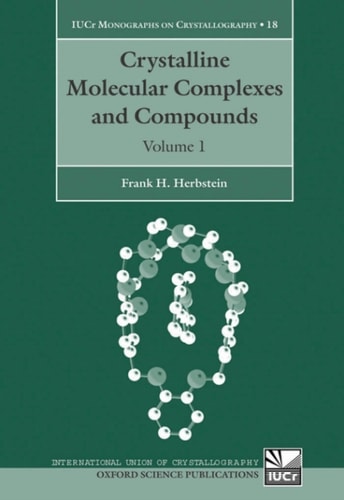
Crystalline Molecular Complexes and Compounds: Structures and Principles
0
0
As an Amazon Associate and affiliate partner, Menrva Books earns from qualifying purchases. Learn more
Author Description
This book provides a comprehensive and unified account of the structure and properties of crystalline binary adducts. Perhaps better known as molecular complexes and compounds, these crystals are currently estimated (from molecular recognition studies) to make up one quarter of the world's crystals, providing evidence for some sort of special attraction between the two components. DNA is perhaps the most famous example but others (hydrates, solvates, host-guest inclusion complexes, donor-acceptor compounds) pervade the whole body of solid state chemistry. Although much research has been published, there has never been a comprehensive and unified treatment of the whole field. This book has been designed to fill this gap, comparing and contrasting the various examples and the different types of interaction (hydrogen bonding, inclusion and localized or delocalized charge transfer). More than 600 figures, 200 tables and 3500 references are included in the book. Since most 'parent compounds' form a number of adducts, the fraction of crystalline binary adducts is only going to grow making this account just the 'tip of the iceberg'.
Menrva's Summary
THE THESIS
This text investigates the structural principles and chemical properties of crystalline binary adducts, addressing the lack of a unified treatment for these pervasive molecular complexes. Frank H. Herbstein, a noted authority in crystallography, synthesizes decades of research to categorize various adduct types, including hydrates, solvates, and donor-acceptor compounds. The work establishes a framework for understanding the intermolecular forces—such as hydrogen bonding and charge transfer—that govern the formation of these structures across diverse chemical systems.
THE SCOPE MAP
What You Will Find
- Comprehensive classification of binary adducts including host-guest inclusion complexes and DNA structures
- Comparative analysis of interaction mechanisms like localized and delocalized charge transfer
- Extensive empirical data supported by over 600 figures and 200 tables
- A bibliography containing 3500 references for further investigation
Scope Limits
- The text focuses primarily on crystalline binary adducts and does not cover non-crystalline or multi-component complex systems in equal depth
- It serves as a foundational overview rather than an exhaustive catalog of every known molecular complex
THE AUTHORITY PERSPECTIVE
Experts recognize this monograph as a definitive reference for researchers in solid-state chemistry and structural biology. Readers frequently note the high density of technical data and the rigorous academic approach required to navigate the extensive literature review provided.
Page Count:
1352
Publication Date:
2005-01-01
Publisher:
OUP Oxford
ISBN-10:
0191523577
ISBN-13:
9780191523571
Science
Chemistry
Solid state chemistry
Earth Sciences
Reference
Community Tags
Other Editions(3)
Similar Books