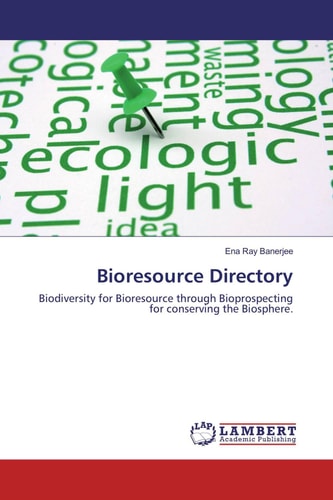
Bioresource Directory: Biodiversity for Bioresource Through Bioprospecting for Conserving the Biosphere
0
0
As an Amazon Associate and affiliate partner, Menrva Books earns from qualifying purchases. Learn more
Author Description
Bioresource Directory aims to promote the need for preserving biodiversity in heritage archives to understand through in-depth research and development, the core information embedded in each organism that talks about a younger earth, gone long past. It is through molecular taxonomy, taphonomy, forensic studies, correlation of gene clusters with signature environmental factors, and DNA bar coding, that the public may be made aware of the need to conserve, the scholars to preserve, and the scientists to explore and understand each organism that ever existed on earth. By sensitizing both academia and the general public, of the need for bioresource generation in an economically viable but non-exploitative environmentally sustainable model, detailed information garnered from a digital inventory created during the systematic restoration and upgradation of a centenary heritage zoological museum kept in Kolkata, which was made by zoological field trips by students, scholars and teachers, by donations from private collections and bought commercially to build a teaching museum. It is being made into an interpretive educational center of excellence for human resource training in Zooarcheology
Menrva's Summary
THE THESIS
The book investigates how preserving biodiversity in heritage archives through advanced research methods can illuminate the past and inform future conservation efforts. It details the importance of molecular taxonomy, taphonomy, forensic studies, gene cluster correlation, and DNA barcoding to raise public awareness and scholarly engagement with organisms. The work emphasizes the creation of bioresources through economically viable, environmentally sustainable models, drawing on data from a restored centenary zoological museum in Kolkata. This initiative aims to establish an interpretive educational center for training in Zooarcheology.
THE SCOPE MAP
- The necessity of preserving biodiversity within heritage archives.
- Methodologies including molecular taxonomy, taphonomy, forensic studies, and DNA barcoding.
- The correlation of gene clusters with signature environmental factors.
- Strategies for bioresource generation that are economically viable and environmentally sustainable.
- Case study of a centenary heritage zoological museum in Kolkata.
- Information garnered from a digital inventory created during museum restoration.
- The establishment of an interpretive educational center for Zooarcheology training.
THE AUTHORITY PERSPECTIVE
The book presents a comprehensive approach to biodiversity preservation, advocating for the integration of scientific research with public education and museum studies. Its focus on molecular techniques and heritage archives suggests a text aimed at both specialists and those interested in conservation science. The detailed account of the Kolkata museum's restoration and its transformation into an educational center highlights practical applications of bioresource management and zooarcheological training.
Page Count:
316
Publication Date:
2017-01-01
Publisher:
LAP LAMBERT Academic Publishing
ISBN-10:
3330028947
ISBN-13:
9783330028944
Non-Fiction
Science
Conservation
Biodiversity
Community Tags
Similar Books