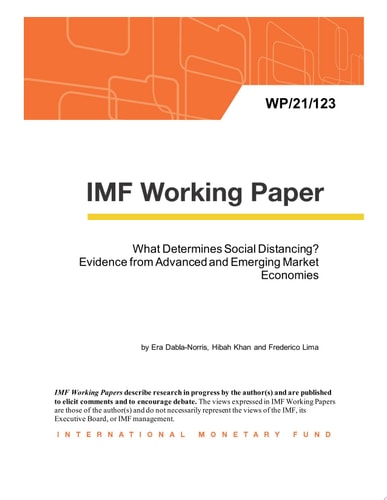
What Determines Social Distancing? Evidence from Advanced and Emerging Market Economies
0
0
As an Amazon Associate and affiliate partner, Menrva Books earns from qualifying purchases. Learn more
Author Description
The health and economic consequences of COVID-19 are closely tied to individual compliance with recommended protective behaviors. We examine the determinants of this compliance using survey data from the COVID Behavior Tracker for 29 advanced and emerging market economies between March and December 2020. Social distancing behaviors vary significantly by age, gender, occupation, and individual beliefs about COVID-19. In addition, those who trust their government’s response to COVID-19 are significantly more likely to adopt recommended behaviors and to self-isolate if advised, highlighting the need for well-coordinated actions on the health and economic fronts. We also find that mobility restrictions, such as stay-at-home orders, and mask mandates are associated with reduced social interactions and persistent increases in compliance. Together, these drivers account for over two-thirds of the regional differences in compliance, confirming their important role in increasing social distancing and containing the pandemic.
Menrva's Summary
THE THESIS
This study investigates the factors influencing public adherence to social distancing measures during the COVID-19 pandemic. The research analyzes survey data from the COVID Behavior Tracker, collected between March and December 2020 across 29 advanced and emerging market economies. It identifies key determinants of compliance, including demographic variables such as age, gender, and occupation, as well as individual beliefs about the virus. The study also highlights the critical role of trust in government response and the impact of policy interventions like mobility restrictions and mask mandates on social distancing behaviors.
THE SCOPE MAP
- Analysis of survey data from the COVID Behavior Tracker (March-December 2020).
- Examination of 29 advanced and emerging market economies.
- Identification of demographic determinants of social distancing (age, gender, occupation).
- Assessment of the influence of individual beliefs about COVID-19 on compliance.
- Evaluation of the correlation between trust in government response and adherence to protective behaviors.
- Impact of mobility restrictions (e.g., stay-at-home orders) on social interactions.
- Effectiveness of mask mandates in increasing compliance.
- Quantification of drivers accounting for regional differences in compliance.
THE AUTHORITY PERSPECTIVE
This research provides a data-driven analysis of social distancing compliance during the COVID-19 pandemic, drawing on a broad international dataset. The findings underscore the importance of government trust and effective policy implementation in shaping public behavior during health crises. The study's focus on both individual-level factors and governmental actions offers a comprehensive perspective on pandemic response strategies. Its conclusions highlight the interconnectedness of health and economic policies in managing public health emergencies.
Page Count:
35
Publication Date:
2021-05-01
Publisher:
International Monetary Fund
ISBN-10:
1513582380
ISBN-13:
9781513582382
Economics
Health
Non-Fiction
Social Science
Sociology
Public Health
COVID-19
Community Tags
Similar Books