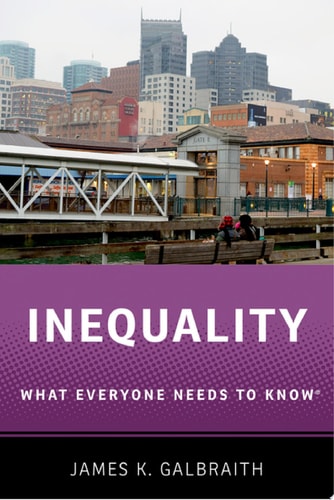
Inequality: What Everyone Needs to Know®
0
0
As an Amazon Associate and affiliate partner, Menrva Books earns from qualifying purchases. Learn more
Author Description
Over the past thirty years, the issue of economic inequality has emerged from the backwaters of economics to claim center stage in the political discourse of America and beyond---a change prompted by a troubling fact: numerous measures of income inequality, especially in the United States in the last quarter of the twentieth century, have risen sharply in recent years. Even so, many people remain confused about what, exactly, politicians and media persons mean when they discuss inequality. What does "economic inequality" mean? How is it measured? Why should we care? Why did inequality rise in the United States? Is rising inequality an inevitable feature of capitalism? What should we do about it? Inequality: What Everyone Needs to Know takes up these questions and more in plain and clear language, bringing to life one of the great economic and political debates of our age. Inequality expert James K. Galbraith has compiled the latest economic research on inequality and explains his findings in a way that everyone can understand. He offers a comprehensive introduction to the study of economic inequality, including its philosophical and theoretical origins, the variety of concepts in wide use, empirical measures and their advantages and disadvantages, competing modern theories of the causes and effects of rising inequality in the United States and worldwide, and a range of policy measures.The topic of economic inequality is going to become only more important as we approach the 2016 presidential elections. This latest addition to the popular What Everyone Needs to Know series from Oxford University Press will tell you everything you need to know to make informed opinions on this significant issue.
Menrva's Summary
THE THESIS
This book investigates the fundamental definitions, causes, and societal implications of economic inequality in the modern era. James K. Galbraith, a prominent economist and professor, synthesizes decades of research to clarify how inequality is measured and why it has become a central concern in contemporary political discourse. He provides a structured framework for understanding the divergence between theoretical economic models and empirical data regarding income distribution.
THE SCOPE MAP
What You Will Find
- Analysis of income inequality trends in the United States and globally
- Explanation of various statistical tools and metrics used to measure wealth disparity
- Philosophical and theoretical foundations of economic inequality
- Evaluation of policy interventions and their potential impacts
Scope Limits
- Does not provide a singular political manifesto or partisan solution
- Focuses primarily on economic and structural factors rather than individual psychological case studies
THE AUTHORITY PERSPECTIVE
Experts recognize this text as a highly accessible primer for those seeking to understand the complexities of economic disparity without navigating dense academic jargon. Readers frequently note that the book serves as a balanced, foundational resource for navigating the technical and political debates surrounding income distribution.
Page Count:
223
Publication Date:
2016-01-01
Publisher:
Oxford University Press
ISBN-10:
0190250496
ISBN-13:
9780190250492
Economics
Sociology
Public Policy
Social Science
Community Tags
Similar Books