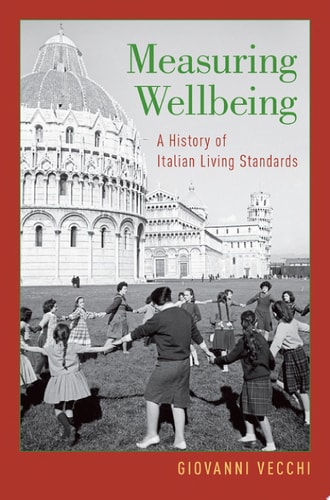
Measuring Wellbeing: A History of Italian Living Standards
0
0
As an Amazon Associate and affiliate partner, Menrva Books earns from qualifying purchases. Learn more
Author Description
In 150 years Italy transformed itself from a poor and backward country into one where living standards are among the highest in the world. In Measuring Wellbeing, Giovanni Vecchi provides an innovative analysis of this change by drawing on family accounts that provide engaging insights into life and are the "micro" data that create the foundations for the "macro" picture of variations and fluctuations in the development of Italy.Vecchi provides a nuanced account of the changes. He emphasizes that the concept of wellbeing is multidimensional and must include non-monetary aspects of life: nutrition, health and education, as well as less tangible elements such as freedom or the possibility to exercise one's political rights. The book deals with this polyhedral nature of wellbeing.Among the insights are that Italians succeeded in combining growth with equity, but that the gap between the North and South did not narrow; the while longevity has increased, education has not improved as much as it could have; and that for close to three decades, Italy's virtuous path has come to a halt: the wellbeing of the Italian people is at the crossroads between progress and decline. Measuring Wellbeing engagingly combines a unique dataset and an innovative statistical method that can be adapted to other countries.
Menrva's Summary
THE THESIS
How did Italy evolve from a poor, agrarian society into a modern nation with high living standards, and what metrics best capture this transformation? Giovanni Vecchi, an expert in economic history, utilizes a multidimensional framework to evaluate Italian development over the last 150 years. By integrating micro-level family accounts with macro-economic data, the author argues that wellbeing must be measured through a polyhedral lens that includes nutrition, health, education, and political rights rather than relying solely on monetary indicators.
THE SCOPE MAP
What You Will Find
- A 150-year longitudinal analysis of Italian living standards.
- A multidimensional wellbeing index incorporating health, education, and political freedom.
- Statistical methodologies for analyzing historical family accounts.
Scope Limits
- The study focuses specifically on the Italian experience and does not provide a comparative analysis of other European nations.
- The text does not offer policy prescriptions for future economic reform.
THE AUTHORITY PERSPECTIVE
Experts recognize this work as a significant contribution to the field of economic history due to its innovative use of micro-data. Readers frequently note the academic density of the prose, which is balanced by the author's clear articulation of complex statistical methods.
Page Count:
665
Publication Date:
2017-01-01
Publisher:
Oxford University Press
ISBN-10:
0190218843
ISBN-13:
9780190218843
History
Economics
Social Science
Sociology
Italy history
Economics history
European History
Italy
Community Tags
Similar Books