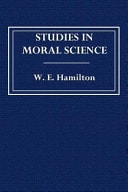
Studies in Moral Science
0
0
As an Amazon Associate and affiliate partner, Menrva Books earns from qualifying purchases. Learn more
Author Description
From the Introduction. Moral Science is the science of duty. The first requisite of any science or of any department of a science is the existence of some well denned body of facts-a group of objects or a succession of events which it is proposed to observe, to classify, or to explain. Any one of these processes of observation, classification, or explanation is scientific; and the merit of any treatment of a given subject will be measured by the accuracy of the observation, the logical character of the classification, and the rationality of the explanation. This first requisite of a science we have; for there is a class of human activities to which the name Duty has been given. This is the field of Moral Science. Every fact relating to the things which men anywhere call duty has a place for treatment in any comprehensive discussion of our subject. It has sometimes been questioned whether a Moral Science is possible. It is said that there is so little agreement among men as to what duty is: that the same conduct is regarded in one community as a duty and in another as a crime; that even the same person, at different periods in life, will hold as duties, actions most diverse. It is argued that in this confusion, order and system and hence science is impossible. Of this objection several things are to be noted: 1. It argues the need of a Moral Science, not the impossibility of it. That the masses of men have widely diverse and often crude and inconsistent ideas of ethical subjects no more proves the impossibility of a Moral Science than the crude notions of the ancients respecting a multitude of physical objects would have proven the impossibility of the modern sciences of Geography, Physics and Chemistry. 2. The objection itself hints at its answer: The reality of duty may be found to lie, not in the substance of being, not in the fact of given actions as such, but in the relations of beings and actions. Some other sciences are as o
Menrva's Summary
THE THESIS
The book investigates the fundamental nature and possibility of a science of duty.
The authors, W. E. Hamilton and W. Hamilton, present Moral Science as the study of duty, asserting that a well-defined body of facts exists for its observation and classification. They address the common objection that the variability and inconsistency of human ethical ideas make a scientific approach impossible. The text argues that this very disagreement highlights the need for a Moral Science, drawing parallels to the development of physical sciences despite early, crude notions. The authors propose that the reality of duty may lie not in actions themselves, but in the relations between beings and actions.
THE SCOPE MAP
- Definition of Moral Science as the science of duty.
- Discussion on the existence of a defined body of facts for moral science.
- Exploration of the scientific processes: observation, classification, and explanation.
- Analysis of the objection that diverse ethical views preclude a science of morals.
- Argument that ethical disagreement necessitates, rather than negates, moral science.
- Comparison of moral science's challenges to those faced by early physical sciences.
- Introduction to the idea that duty resides in relations rather than actions themselves.
THE AUTHORITY PERSPECTIVE
The text, originating from an introduction, lays out a foundational argument for the existence and necessity of Moral Science. It directly confronts skepticism regarding the field's scientific viability by framing ethical diversity as evidence for, not against, the need for systematic study. The authors' approach suggests a rigorous, analytical examination of ethical concepts, aiming to establish order and rationality in the understanding of duty. The framing implies a work intended for serious philosophical inquiry, likely appealing to academics and students of ethics.
Page Count:
300
Publication Date:
2015-02-26
Publisher:
CreateSpace Independent Publishing Platform
ISBN-10:
1508655804
ISBN-13:
9781508655800
Philosophy
Non-Fiction
Moral Philosophy
Ethics
Community Tags
Similar Books