
Persons, Interests, and Justice
0
0
As an Amazon Associate and affiliate partner, Menrva Books earns from qualifying purchases. Learn more
Author Description
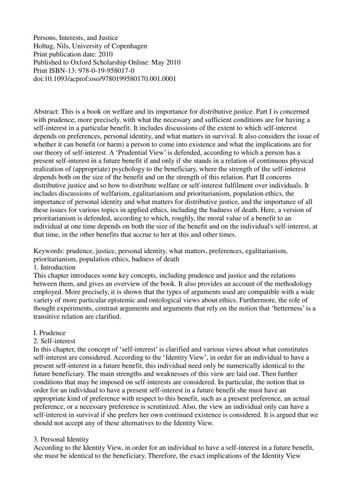
In our lives, we aim to achieve welfare for ourselves, that is, to live good lives. But we also have another, more impartial perspective, where we aim to balance our concern for our own welfare against a concern for the welfare of others. This is a perspective of justice. Nils Holtug examines these two perspectives and the relations between them. The first part of the book is concerned with prudence; more precisely, with what the necessary and sufficient conditions are for having a self-interest in a particular benefit. It includes discussions of the extent to which self-interest depends on preferences, personal identity, and what matters in survival. It also considers the issue of whether it can benefit (or harm) a person to come into existence and what the implications are for our theory of self-interest. A 'prudential view' is defended, according to which a person has a present self-interest in a future benefit if and only if she stands in a relation of continuous physical realization of (appropriate) psychology to the beneficiary, where the strength of the self-interest depends both on the size of the benefit and on the strength of this relation. The second part of the book concerns distributive justice and so how to distribute welfare or self-interest fulfilment over individuals. It includes discussions of welfarism, egalitarianism and prioritarianism, population ethics, the importance of personal identity and what matters for distributive justice, and the importance of all these issues for various topics in applied ethics, including the badness of death. Here, a version of prioritarianism is defended, according to which, roughly, the moral value of a benefit to an individual at a time depends on both the size of the benefit and on the individual's self-interest, at that time, in the other benefits that accrue to her at this and other times.
Menrva's Summary
THE THESIS
This book investigates the conceptual relationship between individual self-interest and the impartial requirements of distributive justice. Nils Holtug, a professor of political philosophy, utilizes analytical frameworks from metaphysics and normative ethics to bridge the gap between prudential concern for one's own welfare and the moral obligations owed to others. He argues for a specific prudential view based on psychological continuity and a version of prioritarianism to resolve conflicts between personal benefit and social distribution.
THE SCOPE MAP
What You Will Find
- Analysis of the conditions for self-interest, including preferences and personal identity.
- Examination of population ethics and the moral implications of coming into existence.
- A comparative study of welfarism, egalitarianism, and prioritarianism.
- Application of these theories to practical issues such as the badness of death.
Scope Limits
- The text does not provide a comprehensive history of political thought, focusing instead on contemporary analytical arguments.
- It does not offer policy prescriptions for specific government programs, remaining within the realm of theoretical ethics.
THE AUTHORITY PERSPECTIVE
Scholars in the field of moral philosophy recognize this work as a rigorous contribution to the debate on the foundations of justice and personal identity. Readers frequently note the academic density of the prose, which requires a strong background in analytical philosophy to fully navigate the author's complex arguments.
Page Count:
352
Publication Date:
2010-01-01
Publisher:
Oxford University Press
ISBN-10:
0191576832
ISBN-13:
9780191576836
Philosophy
Ethics
Political Philosophy
Applied ethics
Metaphysics
Distributive Justice
Conduct Of Life
Community Tags
Other Editions(3)

Similar Books








Reader Comments
Share Your Thoughts
No comments yet. Be the first to share your thoughts!