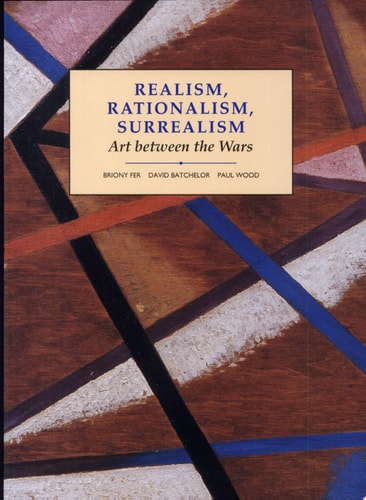
Realism, Rationalism, Surrealism: Art Between the Wars
0
0
As an Amazon Associate and affiliate partner, Menrva Books earns from qualifying purchases. Learn more
Author Description
This is the third in a series of four books about art and its interpretation from the mid-nineteenth century to the end of the twentieth. The books seek to explain the most important issues confronting any study of modern art, without attempting exhaustive coverage. They present a range of approaches characteristic of current art-historical debates. The authors of the present book address debates in, and about, the avant-garde in the years between the two world wars. The first chapter, '"This liberty and this order": art in France after the First World War', considers responses by artists, primarily in France, to the First World War. The emergence of a 'School of Paris', and the competing avant-gardes of Purism, Dada and early Surrealism, is related to the wider social conditions existing in the wake of both devastation and victory. However, there is also a concern to indicate ways in which art can achieve independence from its framing conditions. Chapter 2, 'The language of construction', looks at the emergence of a concept of construction art. The focus is the post-revolutionary Soviet Union, though work in France and Weimar Germany is also considered. There is an examination of why construction proved so powerful a metaphor for artists at this time, and this leads to a consideration of ideas of utility and decoration in art and design. Chapter 3, 'Surrealism, myth and psychoanalysis', considers aspects of Surrealism, with an emphasis on questions of sexual difference. It looks at Surrealism's use of the legacy of Freud, and studies a wide range of textual and photographic sources in addition to paintings. In particular, there is a review of Surrealist magazines and the contributionof Georges Bataille. The final chapter, 'Realisms and realities', addresses the widespread debate over the question of Realism in art. For many, Realism represented an alternative to what was seen as the isolation or even elitism of the avant-garde, a viewpoint that gained support from
Menrva's Summary
THE THESIS
This book investigates the complex artistic movements of Realism, Rationalism, and Surrealism that emerged and contended with each other in the interwar period. It is the third volume in a series examining modern art, focusing on the debates surrounding the avant-garde between World War I and World War II. The authors explore how artists responded to the aftermath of the First World War, the rise of construction art in the Soviet Union and elsewhere, the psychoanalytic underpinnings of Surrealism, and the persistent questions surrounding Realism as an artistic approach.
THE SCOPE MAP
- Analysis of artists' responses to the First World War, particularly in France, and the formation of the 'School of Paris'.
- Exploration of competing avant-garde movements like Purism, Dada, and early Surrealism in relation to social conditions.
- Examination of 'construction art' and its metaphorical power, with a focus on the post-revolutionary Soviet Union, France, and Weimar Germany.
- Discussion of Surrealism's engagement with myth and psychoanalysis, including its use of Freudian legacy and sexual difference.
- Review of Surrealist magazines and the contributions of figures like Georges Bataille.
- Consideration of the widespread debate on Realism in art as an alternative to avant-garde isolation.
THE AUTHORITY PERSPECTIVE
This book is part of a series designed to illuminate key issues in modern art, presenting diverse art-historical perspectives. The volume specifically addresses the avant-garde movements between the World Wars, examining their relationship to social conditions and artistic theory. It delves into the specific contexts of post-WWI France, the Soviet Union's construction art, and the psychoanalytic dimensions of Surrealism. The discussions aim to provide insight into the intellectual and creative currents that shaped art during this pivotal era.
Page Count:
342
Publication Date:
1993-01-01
Publisher:
Yale University Press
ISBN-10:
0300055196
ISBN-13:
9780300055191
History
Non-Fiction
Art
Realism
Art History
Avant-garde
Rationalism
Modern Art
Surrealism
Community Tags
Similar Books















Reader Comments
Share Your Thoughts
No comments yet. Be the first to share your thoughts!