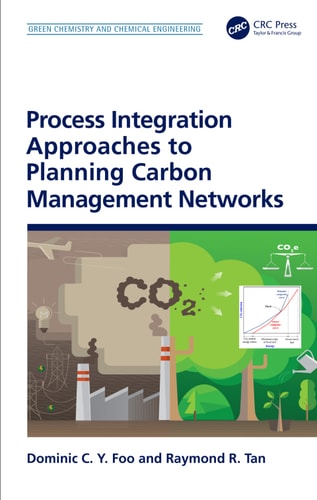
Process Integration Approaches to Planning Carbon Management Networks
0
0
As an Amazon Associate and affiliate partner, Menrva Books earns from qualifying purchases. Learn more
Author Description
Process Integration Approaches to Planning Carbon Management Networks provides a comprehensive treatment of carbon emissions pinch analysis (CEPA), covering the fundamentals as well as more advanced variants based on mathematical programming. A significant portion of the book is dedicated to case studies that provide a range of examples to demonstrate how CEPA can be applied to practical energy planning problems. Selected chapters also include electronic supplements (e.g., spreadsheet templates and software code) to aid the reader in applying these methods to new sets of data. This book is ideal for academic researchers and graduate students interested in carbon-constrained energy planning models and applications. This book Provides essential information on CEPA and mathematical programming Gives illustrative examples and case studies drawn from contemporary climatic issues Covers state-of-the-art methodological developments Discusses about applications in various countries Offers additional support through supplementary spreadsheet templates and software code Professor Dominic Foo is a professor of process design and integration at the University of Nottingham Malaysia. He is a fellow of the Institution of Chemical Engineers, a fellow of the Academy of Science Malaysia, a chartered engineer with the UK Engineering Council, and a professional engineer with the Board of Engineers Malaysia. He works on process integration for resource conservation and CO2 reduction, with more than 400 published works. Prof. Foo is the co-editor-in-chief for Process Integration and Optimization for Sustainability, subject editor for Process Safety & Environmental Protection, and an editorial board member for several other renowned journals. Raymond R. Tan is a professor of chemical engineering and university fellow at De La Salle University, Philippines. He is also a member of the National Academy of Science and Technology of the Philippines. His main areas of research are process syst
Menrva's Summary
THE THESIS
This book investigates the application of process integration techniques, specifically carbon emissions pinch analysis (CEPA), to the complex challenge of planning effective carbon management networks. It delves into the fundamentals of CEPA and its advanced mathematical programming variants, supported by numerous case studies that illustrate practical applications in energy planning. The authors, both distinguished professors in chemical engineering, leverage their extensive research in resource conservation and CO2 reduction to present state-of-the-art methodologies and real-world examples from various countries. The book aims to equip researchers and graduate students with the tools and knowledge to tackle carbon-constrained energy planning problems.
THE SCOPE MAP
- Fundamentals and advanced variants of Carbon Emissions Pinch Analysis (CEPA)
- Application of mathematical programming to CEPA
- Case studies demonstrating CEPA in practical energy planning
- Methodological developments in carbon-constrained energy planning
- Examples of applications in various countries
- Supplementary electronic resources including spreadsheet templates and software code
THE AUTHORITY PERSPECTIVE
This book is positioned as an essential resource for academic researchers and graduate students focused on carbon-constrained energy planning. Its comprehensive treatment of Carbon Emissions Pinch Analysis (CEPA), from foundational concepts to advanced mathematical programming applications, is supported by practical case studies and supplementary digital tools. The authors' established expertise in process integration for CO2 reduction lends significant weight to the presented methodologies and applications.
Page Count:
156
Publication Date:
2020-03-18
Publisher:
Taylor & Francis
ISBN-10:
1351170864
ISBN-13:
9781351170864
Non-Fiction
Science
Community Tags
Similar Books






Reader Comments
Share Your Thoughts
No comments yet. Be the first to share your thoughts!