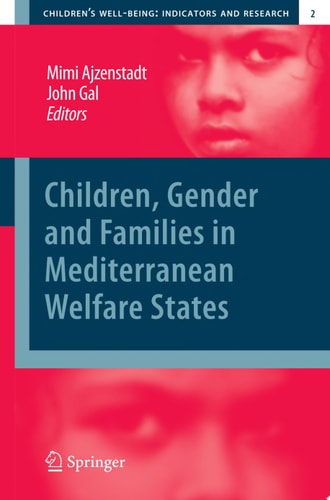
Children, Gender and Families in Mediterranean Welfare States
0
0
As an Amazon Associate and affiliate partner, Menrva Books earns from qualifying purchases. Learn more
Author Description
countries in this region have been particularly limited (for an exception to this, see Petmesidou & Papatheodorou, 2006). The underlying assumption in this volume is that despite the diversity of welfare states bordering the Mediterranean Sea, some interesting commonalities are shared by these nations. Indeed, in his contribution to this volume Gal has described these nations as belonging to an extended family of welfare states that share some common characteristics and outcomes, one of which is the role of the family. By bringing together case analyses of the welfare states in the Mediterranean which focus on children, gender, and families, we maintain that it is possible to shed light on aspects of social policy that do not necessarily emerge in most discussions of these issues in the literature. The rationale inherent in a volume that focuses on a group of welfare states is of course embedded in the welfare regime typology notion that has dominated much of the comparative social policy literature over the last two decades. The publication of Esping Andersen’s seminal work, The Three Worlds of Welfare Capitalism in 1990 (and his related 1999 book), which distinguished between three welfare regimes, became a landmark for comparative work of social policies in various countries. Esping-Andersen regarded his typology as a useful tool for comparison between welfare states because it allowed “for greater analytical parsimony and help[s] us to see the forest rather than myriad trees” (1999, p. 73).
Menrva's Summary
THE THESIS
This volume investigates the shared characteristics and outcomes of welfare states in Mediterranean countries, focusing on the distinct roles of children, gender, and families within their social policies. By analyzing case studies from this region, the book aims to illuminate aspects of social policy often overlooked in broader literature. It builds upon the concept of welfare regime typologies, particularly drawing from Esping-Andersen's influential work, to understand the commonalities and specificities of these nations. The central argument posits that despite regional diversity, a shared family-centric approach offers a unique lens for comparative social policy analysis.
THE SCOPE MAP
- Analysis of social policy in Mediterranean welfare states.
- Focus on the intersection of children, gender, and families.
- Exploration of commonalities and diversity within Mediterranean welfare regimes.
- Application of welfare regime typology for comparative analysis.
- Case studies from various Mediterranean countries.
- Discussion of the role of the family in social policy outcomes.
- Contribution to the literature on comparative social policy.
THE AUTHORITY PERSPECTIVE
This book is positioned as a significant contribution to the comparative study of welfare states, specifically focusing on the under-examined Mediterranean region. Its approach, grounded in established welfare regime typologies, seeks to provide a structured understanding of complex social policies. The collection of case analyses is intended to reveal unique insights into the roles of children, gender, and families that might be missed in more generalized studies.
Page Count:
226
Publication Date:
2010-07-01
Publisher:
Springer Nature
ISBN-10:
9048188423
ISBN-13:
9789048188420
Non-Fiction
Politics
History
Sociology
Gender Studies
Family Studies
Social policy
Community Tags
Similar Books