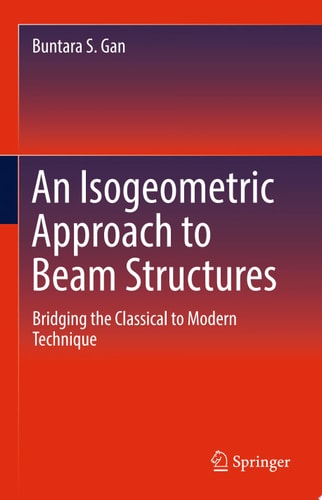
An Isogeometric Approach to Beam Structures
0
0
As an Amazon Associate and affiliate partner, Menrva Books earns from qualifying purchases. Learn more
Author Description
This book proposes a novel, original condensation method to beam formulation based on the isogeometric approach to reducing the degrees of freedom to conventional two-node beam elements. In this volume, the author defines the Buntara Condensation Formulation: a unique formulation in condensing the dynamic equilibrium equation for beam structures, suitable for reducing the number of unlimited dynamic equations necessary to yield a classic two-node beam element. Professor Buntara’s method overcomes the problem of the isogeometric approach where the number of degrees of freedom is increased along with the complexity of the geometrical beam element and facilitates implementation of the codes into the existing beam structures programs, and CAD geometrical data into the conventional FE beam element codes. The book proposes a new reduction method where the beam element can be treated as under the conventional beam element theory that has only two nodes at both ends.
Menrva's Summary
THE THESIS
This book introduces a novel condensation method for beam formulation using the isogeometric approach to reduce degrees of freedom to conventional two-node beam elements. The author, Professor Buntara S. Gan, defines the Buntara Condensation Formulation, a unique method for condensing the dynamic equilibrium equation for beam structures. This formulation addresses the challenge posed by the isogeometric approach, where increased complexity of geometrical beam elements leads to a higher number of degrees of freedom. The method facilitates the integration of codes into existing beam structure programs and CAD geometrical data into conventional FE beam element codes, enabling beam elements to be treated under standard beam element theory with only two nodes.
THE SCOPE MAP
- A novel condensation method for beam formulation based on the isogeometric approach.
- The Buntara Condensation Formulation for reducing dynamic equilibrium equations.
- Techniques for overcoming the increase in degrees of freedom associated with complex geometrical beam elements in the isogeometric approach.
- Methods for facilitating the implementation of codes into existing beam structures programs.
- Strategies for integrating CAD geometrical data into conventional FE beam element codes.
- A framework for treating beam elements under conventional beam element theory with two nodes.
THE AUTHORITY PERSPECTIVE
This work presents a specialized technical contribution to the field of structural mechanics and computational engineering. The Buntara Condensation Formulation is positioned as a unique solution to a known challenge within the isogeometric approach, suggesting a focus on practical implementation and code integration. The book is likely to be of interest to researchers and engineers working with finite element analysis and beam structure modeling.
Page Count:
233
Publication Date:
2017-06-01
Publisher:
Springer Nature
ISBN-10:
3319564935
ISBN-13:
9783319564937
Non-Fiction
Science & Technology
Computational Mechanics
Structural analysis
Engineering
Community Tags
Similar Books