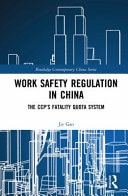
Work Safety Regulation in China: The CCP's Fatality Quota System
0
0
As an Amazon Associate and affiliate partner, Menrva Books earns from qualifying purchases. Learn more
Author Description
Fatality quotas implemented in China's industrial section and local governments are being used to promote work safety and therefore, reducing the number of work-related deaths. Given the controversial nature of this policy, Gao analyzes how the fatality quotas are functioning to aid the country in balancing economic growth and social stability. The book also examines significant implications caused of this policy's implementation in the local regions, and reveals how local officials attempt to handle these problems. This is the first book to systematically examine the role of death indicators in work safety improvement in contemporary China, revealing insight into Beijing's quota-oriented approach to policy-making.
Menrva's Summary
THE THESIS
This book investigates the controversial fatality quota system implemented in China's industrial sector and local governments. Jie Gao analyzes how these quotas function to balance economic growth with social stability, examining their implications on local regions and how officials manage the resulting challenges. As the first systematic examination of death indicators in contemporary Chinese work safety policy, the book offers insight into Beijing's quota-oriented approach to governance.
THE SCOPE MAP
- Analysis of the implementation and functioning of fatality quotas in China's industrial and governmental sectors.
- Examination of the policy's role in balancing economic growth and social stability.
- Exploration of the significant implications of the policy on local regions.
- Investigation into how local officials handle the problems arising from the quota system.
- Systematic review of death indicators as a tool for work safety improvement in contemporary China.
- Insight into Beijing's quota-oriented approach to policy-making.
THE AUTHORITY PERSPECTIVE
The book offers a novel and systematic examination of China's work safety policies, specifically focusing on the controversial fatality quota system. It delves into the complex interplay between economic development, social stability, and the human cost of industrial accidents. The analysis is expected to provide valuable insights for policymakers, researchers, and anyone interested in governance and public safety in China.
Page Count:
248
Publication Date:
2024-01-29
Publisher:
Routledge
ISBN-10:
1032222557
ISBN-13:
9781032222554
Politics
Non-Fiction
Economics
Chinese Politics
Public Policy