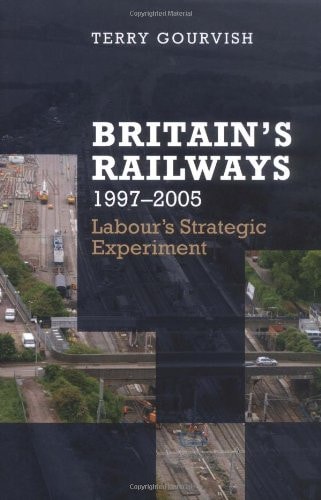
Britain's Railway, 1997-2005: Labour's Strategic Experiment
0
0
As an Amazon Associate and affiliate partner, Menrva Books earns from qualifying purchases. Learn more
Author Description
Britain's leading railway historian provides a critical examination of the Blair governments' involvement in the rail industry from 1997 as they attempted to deal with the UK's fragmented, privatized railways.The book focuses particularly on the work of the Strategic Rail Authority (SRA), and considers the role of individuals --John Prescott, Stephen Byers, Alistair Darling, Sir Alastair Morton, and Richard Bowker--and events--the Hatfield accident (2000), the demise of Railtrack (2001-2), and the funding crisis of 2003-4--in the shaping of emerging policy.The book was commissioned by the SRA, and written with access to government files. Dr. Gourvish argues that the establishment of the SRA as a Non-Departmental Public Board proved largely unsuccessful. It produced tensions with the industry's existing institutions--Railtrack/Network Rail, the operating companies and the economic regulator. There were some gains from the experiment, notably the rescue of the West Coast Main Line project. However, it remains to be seen whether by winding up the SRA and taking responsibility for strategy and funding back into its own hands the Department for Transport has resolved the problem of managing a fragmented industry.This important book is essential reading for those concerned with, and interested in, railway policy, both in the UK and elsewhere in the world.
Menrva's Summary
THE THESIS
This book investigates the efficacy of the Strategic Rail Authority (SRA) as a mechanism for managing the fragmented, privatized railway industry in the United Kingdom between 1997 and 2005. Terry Gourvish, a prominent business historian at the London School of Economics, utilizes exclusive access to government files and internal documentation to analyze the Blair administration's transport policies. The work evaluates the structural tensions between the SRA, regulatory bodies, and private operators, ultimately arguing that the SRA experiment failed to provide a cohesive strategic framework for the rail network.
THE SCOPE MAP
What You Will Find
- Analysis of the SRA's organizational structure and its relationship with the Department for Transport.
- Detailed accounts of major industry events including the Hatfield accident and the collapse of Railtrack.
- Examination of key political figures such as John Prescott, Stephen Byers, and Alistair Darling.
- Assessment of the funding crisis of 2003-4 and the subsequent dissolution of the SRA.
Scope Limits
- The analysis is primarily confined to the period between 1997 and 2005.
- The text focuses on high-level policy and institutional management rather than operational or engineering minutiae.
THE AUTHORITY PERSPECTIVE
Experts recognize this work as a definitive institutional history of the SRA, valued for its unprecedented access to primary government records. Readers frequently note the academic density of the prose, which serves as a foundational text for those studying the complexities of UK transport policy and privatization.
Page Count:
352
Publication Date:
2008-12-15
Publisher:
Oxford University Press, USA
ISBN-10:
0191696706
ISBN-13:
9780191696701
Politics
Economics
History
Economic History
United Kingdom
Public Policy
Railroads
Education & Reference
Transportation
Community Tags
Similar Books