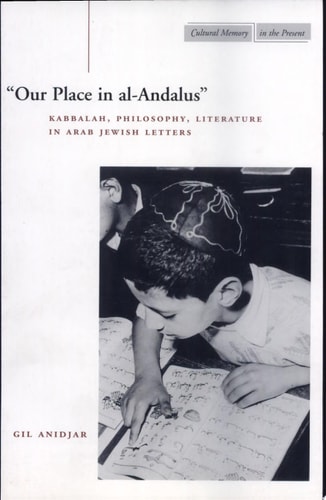
Our Place in al-Andalus: Kabbalah, Philosophy, Literature in Arab Jewish Letters
0
0
As an Amazon Associate and affiliate partner, Menrva Books earns from qualifying purchases. Learn more
Author Description
The year 1492 is only the last in a series of "ends" that inform the representation of medieval Spain in modern Jewish historical and literary discourses. These ends simultaneously mirror the traumas of history and shed light on the discursive process by which hermetic boundaries are set between periods, communities, and texts. This book addresses the representation of the twelfth and thirteenth centuries as the end of al-Andalus (Islamic Spain). Here, the end works to locate and separate Muslim from Christian Spain, Jews from Arabs, philosophy from Kabbalah, Kabbalah from literature, and texts from contexts. The book offers a reading of texts that emerge from its Andalusi, Jewish, and Arabic cultural sphere: Maimonides' Guide of the Perplexed; the major text of Kabbalah, the Zohar; and the Arabic rhymed prose narrative of Ibn al-Astarkuwi. The author argues that these texts are written in a language that disrupts the possibility of locating it in a pre-existing cultural situation, a recognizable literary tradition, or a particular genre. At stake are issues—texts and contexts—that have gained particular urgency in the writings of such recent thinkers as Walter Benjamin, Jacques Derrida, Giorgio Agamben, Jean-Luc Nancy, and Avital Ronell. The book reads the place and taking place of language, interrogating the notion of disappearing contexts and the view that language is derivative of its true place, the context that, having ended, is mourned as silent and lost.
Menrva's Summary
THE THESIS
This book investigates the representation of medieval Spain, specifically al-Andalus, in modern Jewish historical and literary discourses, focusing on how the year 1492 and other 'ends' shape these narratives. Anidjar examines how these discursive boundaries separate periods, communities, and texts, particularly focusing on the 12th and 13th centuries as the end of al-Andalus. The work analyzes key texts such as Maimonides' Guide of the Perplexed, the Zohar, and Ibn al-Astarkuwi's narrative, arguing that their language defies easy categorization within pre-existing cultural, literary, or generic frameworks. The book engages with contemporary thinkers like Walter Benjamin and Jacques Derrida to interrogate the role of language, context, and loss in historical representation.
THE SCOPE MAP
- Analysis of modern Jewish discourses on medieval Spain and al-Andalus.
- Focus on the concept of 'ends' (e.g., 1492) and their role in historical representation.
- Examination of the separation of Muslim from Christian Spain, Jews from Arabs, philosophy from Kabbalah, and Kabbalah from literature.
- Detailed readings of Maimonides' Guide of the Perplexed.
- In-depth study of the Zohar, a foundational text of Kabbalah.
- Analysis of the Arabic rhymed prose narrative by Ibn al-Astarkuwi.
- Discussion of the linguistic properties of these texts and their resistance to categorization.
- Engagement with recent philosophical thought on language, context, and presence.
THE AUTHORITY PERSPECTIVE
This scholarly work delves into complex historical and philosophical interpretations of al-Andalus within Jewish discourse. Its rigorous analysis of foundational texts and engagement with contemporary theory suggests a dense, academic readership. The book's focus on linguistic and discursive boundaries positions it as a significant contribution to medieval studies and the history of ideas.
Page Count:
329
Publication Date:
2002-01-01
Publisher:
Stanford University Press
ISBN-10:
0804741212
ISBN-13:
9780804741217
History
Philosophy
Non-Fiction
Literary Criticism
Jewish Studies
Community Tags
Similar Books