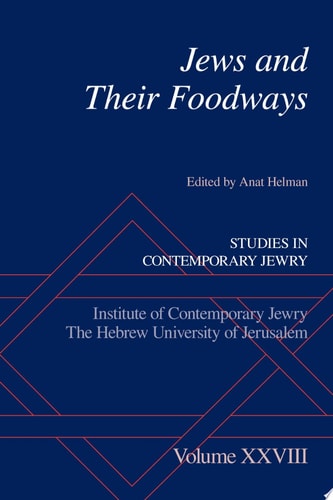
Jews and Their Foodways (Studies in Contemporary Jewry Book 28)
0
0
As an Amazon Associate and affiliate partner, Menrva Books earns from qualifying purchases. Learn more
Author Description
Food is not just a physical necessity but also a composite commodity. It is part of a communication system, a nonverbal medium for expression, and a marker of special events. Bringing together contributions from fourteen historians, anthropologists, sociologists, and literary critics, Volume XXVIII of Studies in Contemporary Jewry presents various viewpoints on the subtle and intricate relations between Jews and their foodways. The ancient Jewish community ritualized and codified the sphere of food; by regulating specific and detailed culinary laws, Judaism extended and accentuated food's cultural meanings. Modern Jewry is no longer defined exclusively in religious terms, yet a decrease in the role of religion, including kashrut observance, does not necessarily entail any diminishment of the role of food. On the contrary, as shown by the essays in this volume, choices of food take on special importance when Jewish individuals and communities face the challenges of modernity.Following an introduction by Sidney Mintz and concluding with an overview by Richard Wilk, the symposium essays lead the reader from the 20th century to the 21st, across Europe, the Middle East, Africa, and North America. Through periods of war and peace, voluntary immigrations and forced deportations, want and abundance, contemporary Jews use food both for demarcating new borders in rapidly changing circumstances and for remembering a diverse heritage.Despite a tendency in traditional Jewish studies to focus on "high" culture and to marginalize "low" culture, Jews and Their Foodways demonstrates how an examination of people's eating habits helps to explain human life and its diversity through no less than the study of great events, the deeds of famous people, and the writings of distinguished rabbis.
Menrva's Summary
THE THESIS
This volume investigates how food functions as a critical marker of identity, communication, and cultural continuity within Jewish communities across the modern era. Edited by Anat Helman, the collection synthesizes research from fourteen scholars—including historians, sociologists, and anthropologists—to argue that culinary practices remain a primary vehicle for expressing Jewishness even as religious observance shifts or declines. By examining foodways as a nonverbal medium, the contributors demonstrate how eating habits serve as a mechanism for navigating the complexities of modernity, migration, and social change.
THE SCOPE MAP
What You Will Find
- Analysis of culinary laws and their evolution from ancient ritual to modern secular practice.
- Comparative studies spanning Europe, the Middle East, Africa, and North America.
- Examination of food as a tool for demarcating borders and preserving heritage during periods of war, immigration, and displacement.
Scope Limits
- The text focuses primarily on the 20th and 21st centuries rather than ancient or medieval culinary history.
- The volume prioritizes sociological and cultural analysis over the provision of historical recipes or culinary techniques.
THE AUTHORITY PERSPECTIVE
Scholars and readers recognize this work as a significant contribution to the field of Jewish studies for its elevation of 'low' culture and daily habits to a subject of serious academic inquiry. The text is noted for its interdisciplinary approach, providing a comprehensive framework for understanding how food serves as a proxy for identity in a globalized context.
Page Count:
335
Publication Date:
2015-01-01
Publisher:
Oxford University Press
ISBN-10:
0190493593
ISBN-13:
9780190493592
History
Religion
Professional Career & Trade
Anthropology
Jewish Studies
Judaism
Sociology
Food Studies
Community Tags
Similar Books