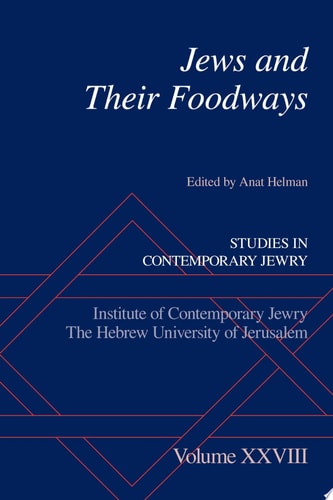
Jews and Their Foodways
0
0
As an Amazon Associate and affiliate partner, Menrva Books earns from qualifying purchases. Learn more
Author Description
Food is not just a physical necessity but also a composite commodity. It is part of a communication system, a nonverbal medium for expression, and a marker of special events. Bringing together contributions from fourteen historians, anthropologists, sociologists, and literary critics, Volume XXVIII of Studies in Contemporary Jewry presents various viewpoints on the subtle and intricate relations between Jews and their foodways. The ancient Jewish community ritualized and codified the sphere of food; by regulating specific and detailed culinary laws, Judaism extended and accentuated food's cultural meanings. Modern Jewry is no longer defined exclusively in religious terms, yet a decrease in the role of religion, including kashrut observance, does not necessarily entail any diminishment of the role of food. On the contrary, as shown by the essays in this volume, choices of food take on special importance when Jewish individuals and communities face the challenges of modernity.Following an introduction by Sidney Mintz and concluding with an overview by Richard Wilk, the symposium essays lead the reader from the 20th century to the 21st, across Europe, the Middle East, Africa, and North America. Through periods of war and peace, voluntary immigrations and forced deportations, want and abundance, contemporary Jews use food both for demarcating new borders in rapidly changing circumstances and for remembering a diverse heritage.Despite a tendency in traditional Jewish studies to focus on "high" culture and to marginalize "low" culture, Jews and Their Foodways demonstrates how an examination of people's eating habits helps to explain human life and its diversity through no less than the study of great events, the deeds of famous people, and the writings of distinguished rabbis.
Menrva's Summary
THE THESIS
This volume investigates how food serves as a critical marker of identity, communication, and cultural continuity for Jewish communities navigating the complexities of modernity. Edited by Anat Helman, this collection synthesizes research from fourteen scholars across history, anthropology, and sociology to examine how culinary practices persist even as religious observance fluctuates. The contributors argue that foodways function as a dynamic system for negotiating heritage and social boundaries in the 20th and 21st centuries.
THE SCOPE MAP
What You Will Find
- Analysis of culinary laws and their evolution from ancient ritual to modern cultural expression.
- Comparative studies spanning Europe, the Middle East, Africa, and North America.
- Examination of food as a response to migration, war, and economic shifts.
Scope Limits
- The text does not provide a comprehensive history of Jewish cuisine or a collection of recipes.
- It focuses primarily on contemporary and modern contexts rather than ancient or medieval culinary history.
THE AUTHORITY PERSPECTIVE
Scholars and students of cultural history frequently cite this volume for its interdisciplinary approach to the intersection of religion and daily life. Experts highlight the work as a significant contribution to the field of food studies, noting its success in elevating the study of eating habits to a serious academic inquiry.
Page Count:
336
Publication Date:
2015-11-30
Publisher:
Oxford University Press
ISBN-10:
0190265426
ISBN-13:
9780190265427
History
Food Studies
Anthropology
Sociology
Jewish Cooking
Jewish Studies
Community Tags
Other Editions(3)

Similar Books















Reader Comments
Share Your Thoughts
No comments yet. Be the first to share your thoughts!