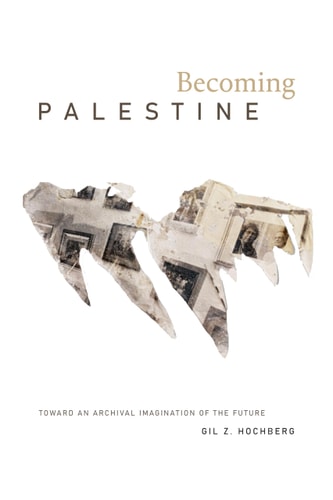
Becoming Palestine: Toward an Archival Imagination of the Future
0
0
As an Amazon Associate and affiliate partner, Menrva Books earns from qualifying purchases. Learn more
Author Description
In Becoming Palestine, Gil Z. Hochberg examines how contemporary Palestinian artists, filmmakers, dancers, and activists use the archive in order to radically imagine Palestine's future. She shows how artists such as Jumana Manna, Kamal Aljafari, Larissa Sansour, Farah Saleh, Basel Abbas, and Ruanne Abou-Rahme reimagine the archive, approaching it not through the desire to unearth hidden knowledge, but to sever the identification of the archive with the past. In their use of archaeology, musical traditions, and archival film and cinematic footage, these artists imagine a Palestinian future unbounded from colonial space and time. By urging readers to think about archives as a break from history rather than as history's repository, Hochberg presents a fundamental reconceptualization of the archive's liberatory potential.
Menrva's Summary
THE THESIS
This book investigates how contemporary Palestinian artists and activists utilize archival materials to construct a vision of the future. Gil Z. Hochberg, a scholar in the field, analyzes the works of artists like Jumana Manna and Kamal Aljafari, demonstrating their innovative approaches to the archive. These artists move beyond a traditional understanding of archives as repositories of the past, instead employing them to break free from historical constraints and colonial frameworks. Through their engagement with archaeology, music, and film, they propose a future for Palestine that is unbound by imposed temporal and spatial limitations.
THE SCOPE MAP
- Analysis of contemporary Palestinian artists, filmmakers, dancers, and activists.
- Exploration of how the archive is reimagined as a tool for future-making, not past-unearthing.
- Case studies of artists including Jumana Manna, Kamal Aljafari, Larissa Sansour, Farah Saleh, Basel Abbas, and Ruanne Abou-Rahme.
- Examination of artistic methods such as the use of archaeology, musical traditions, and archival film footage.
- Argument for the archive's potential to liberate from colonial structures of space and time.
- A reconceptualization of the archive as a site of rupture from history, rather than its mere preservation.
THE AUTHORITY PERSPECTIVE
The book is recognized for its innovative approach to archival studies, particularly within the context of Palestinian art and activism. Critics and scholars are likely to engage with Hochberg's central thesis that archives can serve as a catalyst for imagining futures unbound by colonial legacies. The focus on contemporary artists and their methods suggests a text that bridges theoretical concepts with practical artistic applications, offering a fresh perspective on the liberatory potential of archival engagement. This work is poised to contribute significantly to discussions in cultural studies, art history, and postcolonial theory.
Page Count:
206
Publication Date:
2021-12-06
Publisher:
Duke University Press
ISBN-10:
1478013885
ISBN-13:
9781478013884
Non-Fiction
Art
History
Art History
Film Studies
Performance Studies
Community Tags
Similar Books














