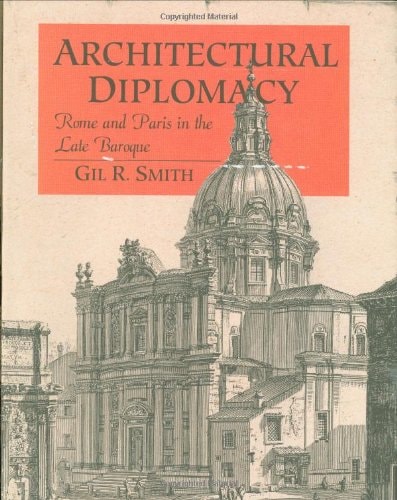
Architectural Diplomacy: Rome and Paris in the Late Baroque
0
0
As an Amazon Associate and affiliate partner, Menrva Books earns from qualifying purchases. Learn more
Author Description
This detailed analysis of a large, unified body of student drawings from the firstpublic competitions of the Accademia di San Luca, held between 1675 and 1700, brings to light acritical juncture in the Late Baroque. In Architectural Diplomacy, Gil Smith observes that at a timewhen building activity in Rome was greatly diminished, the Accademia became a successful laboratoryof ideas where design methods, such as the productive fusing of French and Italian Baroquetraditions, were tested for perhaps the first time before becoming common coin in eighteenth-centuryarchitecture.Smith uses these public competitions, held for the 25 years after the Accademia's unionwith the French academies, as evidence that the Accademia was of central importance to thearchitectural history of the Baroque. It was also a place where new typologies and design methodsarising from exchanges between French and Roman architectural traditions could flourish, and animportant source of inspiration for such prominent architects of the next century as J. B. Fischervon Erlach, Filippo Juvarra, and others who searched for a progressive, synthetic Baroquelanguage.The drawings also provide a means of studying the influence of such teachers andarchitect-academicians as Mattia de Rossi and Carlo Fontana (two heirs of Bernini) on a generationof young architects. Smith points out that it was Fontana in particular who consciously pursuedsynthesis as design methodology in order to revitalize traditions of Roman architecture.Gil R. Smithis Associate Professor of Architecture at Ball State University.
Menrva's Summary
THE THESIS
This book investigates the pivotal role of architectural competitions in Rome during the Late Baroque period as a crucible for synthesizing French and Italian design traditions. Gil Smith, Associate Professor of Architecture at Ball State University, analyzes a comprehensive collection of student drawings from the Accademia di San Luca's competitions between 1675 and 1700. The study posits that despite a decline in Roman construction, the Accademia served as a vital laboratory for developing new design methods and architectural typologies through the fusion of French and Italian Baroque elements. This synthesis, particularly influenced by academicians like Carlo Fontana, laid the groundwork for a progressive Baroque language adopted by prominent architects of the subsequent century.
THE SCOPE MAP
- Analysis of student drawings from the Accademia di San Luca's public competitions (1675-1700).
- Examination of the fusion of French and Italian Baroque architectural traditions.
- Exploration of the Accademia di San Luca as a laboratory for design ideas during a period of diminished building activity in Rome.
- Study of new typologies and design methods arising from Franco-Roman architectural exchanges.
- Investigation into the influence of teachers and architect-academicians, such as Mattia de Rossi and Carlo Fontana, on a generation of young architects.
- Focus on Carlo Fontana's conscious pursuit of synthesis as a design methodology to revitalize Roman architecture.
- Identification of inspiration for architects like J. B. Fischer von Erlach and Filippo Juvarra.
THE AUTHORITY PERSPECTIVE
This scholarly work is recognized for its detailed analysis of a specific, unified body of student drawings, offering a critical perspective on the Late Baroque period. The book's strength lies in its examination of the Accademia di San Luca's competitions as a crucial site for architectural innovation and the cross-pollination of French and Italian design ideas. Scholars likely appreciate its focus on the pedagogical and developmental aspects of architectural practice during this era, highlighting the influence of key figures on subsequent generations.
Page Count:
379
Publication Date:
1993-04-13
Publisher:
The MIT Press
ISBN-10:
026219323X
ISBN-13:
9780262193238
Non-Fiction
Architecture
History
Art History
European History
Community Tags
Similar Books














