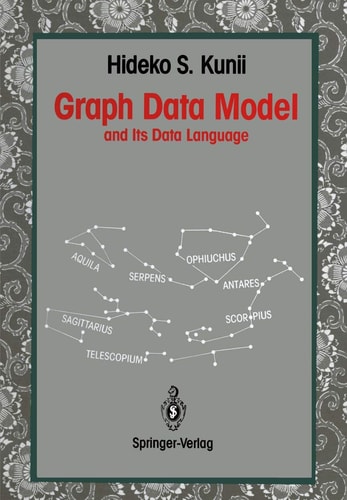
Graph Data Model and Its Data Language
0
0
As an Amazon Associate and affiliate partner, Menrva Books earns from qualifying purchases. Learn more
Author Description
Complex databases can be understood well with visual representation. A graph is a very intuitive and rational structure to visually represent such databases. Graph Data Model (GDM) proposed by the author formalizes data representation and operations on the data in terms of the graph concept. The GDM is an extension of the relational model toward structural representation. In this model, a database is defined by a schema graph where nodes represent record types and arcs represent link types that are relationships between two record types. The capabilities of the GDM include direct representation of many-to-many relationships and of the relationships within a single record type. The characteristic operators are those associated with links: existential, universal, numerical and transitive link operators. Graph Data Language (GDL) is a data language based on this GDM. The essence of the GDL is path expressions used for formulation of queries. The concepts of GDM and GDL have actually been implemented by Ricoh Co., Ltd. and a system based on these concepts is commercially available for many UNIX machines.
Menrva's Summary
THE THESIS
This book introduces a formal Graph Data Model (GDM) and its associated Graph Data Language (GDL) for representing and manipulating complex databases. The authors, Gio Wiederhold and Hideko S. Kunii, propose GDM as an extension of the relational model, utilizing a schema graph where nodes signify record types and arcs represent link types that define relationships between them. This model uniquely handles many-to-many relationships and intra-record relationships, supported by characteristic operators for links such as existential, universal, numerical, and transitive. GDL, built upon GDM, employs path expressions for query formulation, and the concepts have been implemented and commercially released.
THE SCOPE MAP
- Formalization of database representation using graph theory concepts.
- Explanation of the Graph Data Model (GDM) as an extension of the relational model.
- Description of schema graphs with nodes for record types and arcs for link types.
- Capabilities for representing many-to-many relationships and relationships within a single record type.
- Introduction to characteristic link operators: existential, universal, numerical, and transitive.
- Details on the Graph Data Language (GDL) and its use of path expressions for queries.
- Information on the practical implementation and commercial availability of the GDM/GDL system.
THE AUTHORITY PERSPECTIVE
This work presents a specialized approach to database modeling, likely appealing to computer scientists and database architects familiar with relational models. The formalization of graph-based data representation and the introduction of a specific data language suggest a technical and academic audience. The mention of a commercial implementation indicates practical relevance beyond theoretical concepts.
Page Count:
106
Publication Date:
1990-09-07
Publisher:
Springer
ISBN-10:
4431700587
ISBN-13:
9784431700586
Science & Technology
Non-Fiction
Databases
Data Modeling
Computer Science
Information Systems
Community Tags
Similar Books