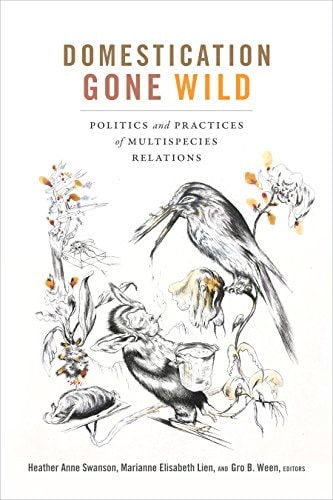
Domestication Gone Wild: Politics and Practices of Multispecies Relations
0
0
As an Amazon Associate and affiliate partner, Menrva Books earns from qualifying purchases. Learn more
Author Description
The domestication of plants and animals is central to the familiar and now outdated story of civilization's emergence. Intertwined with colonialism and imperial expansion, the domestication narrative has informed and justified dominant and often destructive practices. Contending that domestication retains considerable value as an analytical tool, the contributors to Domestication Gone Wild reengage the concept by highlighting sites and forms of domestication occurring in unexpected and marginal sites, from Norwegian fjords and Philippine villages to British falconry cages and South African colonial townships. Challenging idioms of animal husbandry as human mastery and progress, the contributors push beyond the boundaries of farms, fences, and cages to explore how situated relations with animals and plants are linked to the politics of human difference—and, conversely, how politics are intertwined with plant and animal life. Ultimately, this volume promotes a novel, decolonizing concept of domestication that radically revises its Euro- and anthropocentric narrative. Contributors. Inger Anneberg, Natasha Fijn, Rune Flikke, Frida Hastrup, Marianne Elisabeth Lien, Knut G. Nustad, Sara Asu Schroer, Heather Anne Swanson, Anna Lowenhaupt Tsing, Mette Vaarst, Gro B. Ween, Jon Henrik Ziegler Remme
Menrva's Summary
THE THESIS
This book challenges the traditional narrative of domestication as a linear progression of human civilization and control over nature. It re-examines the concept of domestication by exploring its presence in unexpected and marginalized contexts, arguing that these practices are deeply intertwined with the politics of human difference and the broader political landscape.
THE SCOPE MAP
- Analysis of domestication in diverse global sites, including Norwegian fjords, Philippine villages, British falconry, and South African colonial townships.
- A critique of the notion of animal husbandry as solely human mastery and progress.
- Exploration of how situated human-animal and human-plant relationships connect to the politics of human difference.
- A decolonizing and anthropocentric revision of the concept of domestication.
- Contributions from a range of scholars in anthropology, sociology, and related fields.
THE AUTHORITY PERSPECTIVE
The collection re-engages the concept of domestication, moving beyond traditional anthropocentric and Eurocentric frameworks. By examining diverse and often overlooked sites of domestication, the contributors highlight its complex relationship with colonialism, imperial expansion, and the politics of human difference. The volume aims to promote a novel, decolonizing understanding of domestication, challenging established narratives of human mastery over plants and animals.
Page Count:
272
Publication Date:
2018-10-19
Publisher:
Duke University Press
ISBN-10:
0822371332
ISBN-13:
9780822371335
Non-Fiction
Politics
History
Anthropology
Sociology
Community Tags
Similar Books














