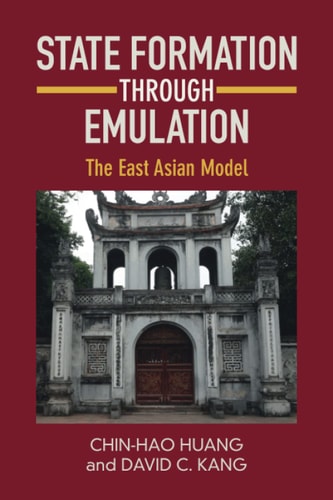
State Formation through Emulation: The East Asian Model
0
0
As an Amazon Associate and affiliate partner, Menrva Books earns from qualifying purchases. Learn more
Author Description
Neither war nor preparations for war were the cause or effect of state formation in East Asia. Instead, emulation of China-the hegemon with a civilizational influence-drove the rapid formation of centralized, bureaucratically administered, territorial governments in Korea, Japan, and Vietnam. Furthermore, these countries engaged in state-building not to engage in conflict or to suppress revolt. In fact, war was relatively rare and there was no balance of power system with regular existential threats-the longevity of the East Asian dynasties is evidence of both the peacefulness of their neighborhood and their internal stability. We challenge the assumption that the European experience with war and state-making was universal. More importantly, we broaden the scope of state formation in East Asia beyond the study of China itself and show how countries in the region interacted and learned from each other and China to develop strong capacities and stable borders.
Menrva's Summary
THE THESIS
The formation of states in East Asia was driven not by conflict, but by emulation of the dominant power, China. The authors challenge the prevailing European model of state-making through war, arguing that Korea, Japan, and Vietnam developed centralized, bureaucratic governments through a process of imitation and learning from China and each other. This emulation led to the establishment of stable dynasties, characterized by relative peace and internal stability, rather than constant warfare or existential threats.
THE SCOPE MAP
- Analysis of state formation in Korea, Japan, and Vietnam.
- Examination of the role of China as a civilizational hegemon.
- Challenge to the universality of the European war-driven state-making model.
- Exploration of emulation and learning as drivers of state capacity.
- Discussion of the relative rarity of war and stability in the East Asian region.
- Broadening the scope of East Asian state formation beyond China alone.
THE AUTHORITY PERSPECTIVE
This book presents a novel framework for understanding state formation in East Asia, directly contrasting it with the more commonly studied European experience. The authors' argument that emulation, rather than conflict, was the primary driver of state development in countries like Korea, Japan, and Vietnam offers a significant reinterpretation of regional history. The work is likely to be of interest to scholars of comparative politics, Asian studies, and historical sociology. Its focus on inter-state learning and the peaceful nature of regional power dynamics provides a unique perspective on the development of stable, centralized governments.
Page Count:
270
Publication Date:
2022-08-04
Publisher:
Cambridge University Press
ISBN-10:
1009096311
ISBN-13:
9781009096317
History
Non-Fiction
Comparative Politics
Asian Studies
Community Tags
Similar Books