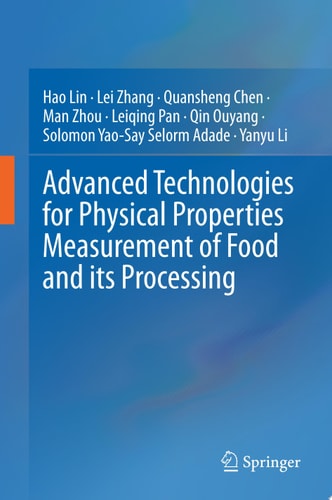
Advanced Technologies for Physical Properties Measurement of Food and its Processing
0
0
As an Amazon Associate and affiliate partner, Menrva Books earns from qualifying purchases. Learn more
Author Description
This book provides a comprehensive overview of the physical properties of foods and the cutting-edge technologies employed to measure them. Delving into key topics such as optical, thermal, acoustic, rheological, and textural properties, it provides a detailed examination of principles, measurement methods, and applications in food quality evaluation. While it discusses advanced technologies such as near-infrared spectroscopy, computer vision, spectral imaging, acoustic resonance analysis, electronic noses/tongues/eyes, and multi-sensor data fusion in detail, the book also introduces intelligent equipment design and real-time quality monitoring systems for the food industry, including emerging technologies like 4D printing and terahertz technology. The book also addresses critical questions about the application of these technologies in real-world scenarios, making it a must-read for those seeking to understand and apply the latest advancements in food science. This book is an invaluable resource for undergraduate and graduate students, researchers, and professionals in food science and engineering. It helps readers understand the principles of various non-destructive food quality measurement techniques and applies them to in-situ evaluation and in-field monitoring. It also serves as both a textbook and a reference guide, enabling readers to understand and apply advanced measurement and processing techniques for in-situ evaluation and in-field monitoring. By providing a thorough understanding of the principles and applications of food physical properties, this book ensures that its audience remains at the forefront of technological advancements in the field. The book contains several chapters originally written in the Chinese language. The translation was done with the help of artificial intelligence. A subsequent human revision was done primarily in terms of content.
Menrva's Summary
THE THESIS
This book investigates the cutting-edge technologies used to measure the physical properties of food and its processing. It provides a comprehensive overview of optical, thermal, acoustic, rheological, and textural properties, detailing measurement methods and their applications in food quality evaluation. The text examines advanced techniques such as near-infrared spectroscopy, computer vision, spectral imaging, acoustic resonance analysis, electronic noses/tongues/eyes, and multi-sensor data fusion. Furthermore, it introduces intelligent equipment design, real-time quality monitoring systems, and emerging technologies like 4D printing and terahertz technology for the food industry.
THE SCOPE MAP
- Detailed examination of optical, thermal, acoustic, rheological, and textural properties of food.
- In-depth discussion of advanced measurement technologies including near-infrared spectroscopy, computer vision, and spectral imaging.
- Exploration of electronic noses, tongues, and eyes, alongside acoustic resonance analysis.
- Coverage of multi-sensor data fusion and its applications in food quality evaluation.
- Introduction to intelligent equipment design and real-time quality monitoring systems.
- Discussion of emerging technologies such as 4D printing and terahertz technology in food processing.
- Application of non-destructive food quality measurement techniques for in-situ evaluation and in-field monitoring.
THE AUTHORITY PERSPECTIVE
This book is positioned as an invaluable resource for undergraduate and graduate students, researchers, and professionals in food science and engineering. It aims to equip readers with a thorough understanding of the principles and applications of food physical properties, ensuring they remain at the forefront of technological advancements. The inclusion of chapters originally in Chinese, translated with AI and human revision, suggests a broad scope and an effort to bridge language barriers in scientific dissemination.
Page Count:
363
Publication Date:
2025-02-11
Publisher:
Springer Nature
ISBN-10:
9819623472
ISBN-13:
9789819623471
Non-Fiction
Science
Measurement
Engineering
Food Science
Technology
Quality Control
Community Tags
Similar Books




Reader Comments
Share Your Thoughts
No comments yet. Be the first to share your thoughts!