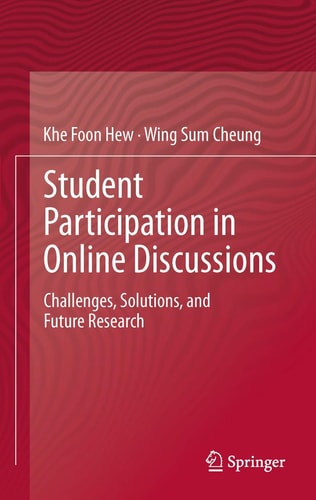
Student Participation in Online Discussions: Challenges, Solutions, and Future Research
0
0
As an Amazon Associate and affiliate partner, Menrva Books earns from qualifying purchases. Learn more
Author Description
The increasingly prevalent use of online- or blended-learning in schools universities has resulted in asynchronous online discussion forum becoming an increasingly common means to facilitate dialogue between instructors and students, as well as students and students beyond the boundaries of their physical classrooms. This proposed academic book contributes to the literature on asynchronous online discussions in the following three main ways: First, it reviews previous research studies in order to identify the factors leading to limited student contribution. Limited student contribution is defined as students making few or no postings, students exhibiting surface-level thinking or students demonstrating low-level knowledge construction in online discussions. It then identifies the various empirically-based guidelines to address the factors. Second, three potential guideline dilemmas that educators may encounter: (a) use of grades, (b) use of number of posting guideline, and (c) instructor-facilitation are introduced. These are guidelines where previous empirical research shows mixed results when they are implemented. Acknowledging the dilemmas is essential for educators and researchers to make informed decisions about the discussion guidelines they are considering implementing. Third, nine exploratory case studies related to student-facilitation and audio-based discussion are reported on and examined. Using students as facilitators may be an alternative solution to educators who wish to avoid the instructor-facilitation guideline dilemma. Using audio discussion would be useful for participants with poor typing skills or those who prefer talking to typing. The proposed book is distinctive in comparison to current competitor titles because all the findings and guidelines are empirically-based. Furthermore, the nine expanded case studies provided specifically address the issue of student/peer facilitation and audio-based discussion. Student/peer facilitation and audio d
Menrva's Summary
THE THESIS
This book investigates the persistent challenge of limited student participation in online discussion forums and proposes empirically-based solutions. It addresses the core problem of why students contribute minimally, exhibit surface-level thinking, or demonstrate low-level knowledge construction in these digital spaces. The authors review existing research to identify these contributing factors and then present evidence-based guidelines to mitigate them, while also exploring potential dilemmas educators face with grading, posting requirements, and instructor facilitation. The work further examines nine exploratory case studies on student-led facilitation and audio-based discussions as alternative approaches.
THE SCOPE MAP
- Review of research identifying factors leading to limited student contribution in online discussions.
- Empirically-based guidelines to address factors of limited student contribution.
- Discussion of three guideline dilemmas for educators: use of grades, number of postings, and instructor facilitation.
- Analysis of mixed results from previous empirical research on these guidelines.
- Presentation of nine exploratory case studies on student-facilitation.
- Examination of nine exploratory case studies on audio-based discussion forums.
- Focus on findings and guidelines that are empirically-based.
- Exploration of student/peer facilitation as an alternative to instructor facilitation.
THE AUTHORITY PERSPECTIVE
This book offers a research-driven examination of a critical aspect of modern education, providing educators and researchers with empirically-supported strategies for enhancing online discussions. Its strength lies in synthesizing existing literature and presenting practical, evidence-based guidelines, while also acknowledging the complexities and mixed results associated with common facilitation techniques. The inclusion of case studies on student facilitation and audio discussions offers novel perspectives and potential solutions for diverse learning environments. The work is positioned as a valuable resource for those seeking to improve the effectiveness and engagement within asynchronous online learning platforms.
Page Count:
142
Publication Date:
2014-07-17
Publisher:
Springer New York
ISBN-10:
1489994149
ISBN-13:
9781489994141
Science & Technology
Non-Fiction
Pedagogy
Online Learning
Education
Research Methods
Community Tags
Other Editions(2)
Similar Books







Reader Comments
Share Your Thoughts
No comments yet. Be the first to share your thoughts!