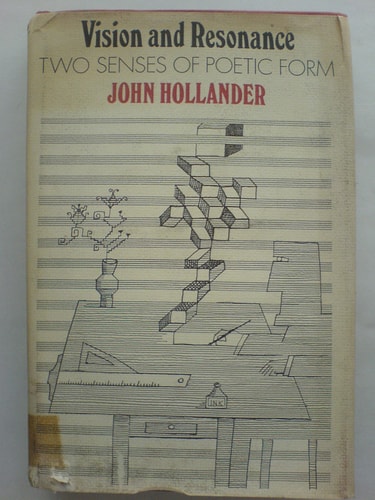
Vision and Resonance: Two Senses of Poetic Form
0
0
As an Amazon Associate and affiliate partner, Menrva Books earns from qualifying purchases. Learn more
Author Description
Hollander's a formalist inchworm with an extraordinary sensitivity to the calibrations of style. These essays, written over the last twenty years, hang together as a poetics of English verse from Chaucer to W. C. Williams, with homage paid to poet-composer-theoretician Campion, to Donne for a metrical roughness which shifts meaning through those jagged rhythms, to Milton for his innovative "variety of pauses" and especially to Jonson, seen here as a proto-Augustan, in a very loving appreciation of his technical mastery. Hollander's units of measure include enjambment and quantity as well as rhyme and meter; and though there's attention to the poem as inscription he mostly treats verse as an aural experience. This is Emily "Using a base of the so-called 'common meter' of hymnody--the accentual version in 4-beat and 3-beat alternating lines of the tetrameter-trimeter abcb rhyming quatrain also loosely called 'ballad stanza'--she derived an intense, chromatic, often deliberately soured, solo hymnody of her own." While mindful of the 20th century movement toward personal meter and eclecticism, Hollander is a joyful taxonomist. Curled comfortably around the roots of Classical and English prosody, he's almost nostalgic for the pristine structures of an earlier order.
Menrva's Summary
THE THESIS
How do the visual and auditory dimensions of poetic form interact to shape the meaning and reception of English verse? John Hollander, a distinguished scholar and poet, examines the technical mechanics of English prosody by analyzing the interplay between written inscription and aural experience. Drawing on a career of critical inquiry, he argues that the structural choices made by poets—from the rhythmic innovations of Milton to the metrical precision of Jonson—are fundamental to the semantic depth of their work.
THE SCOPE MAP
What You Will Find
- A comprehensive analysis of English verse spanning from Chaucer to William Carlos Williams.
- Detailed examinations of technical devices including enjambment, quantity, rhyme, and meter.
- Comparative studies of historical figures such as Campion, Donne, Milton, and Jonson.
- A theoretical framework that treats poetry as both a visual inscription and an aural performance.
THE AUTHORITY PERSPECTIVE
Scholars and critics recognize this work as a sophisticated contribution to the study of prosody, often noting the author's meticulous attention to technical detail. It is frequently cited as a foundational text for those interested in the formalist tradition of English poetry analysis.
Page Count:
328
Publication Date:
1975-01-01
Publisher:
Oxford University Press
ISBN-10:
0195018982
ISBN-13:
9780195018981
Non-Fiction
Poetry
Academic
Poetry
Literary Criticism
Prosody
Community Tags
Similar Books