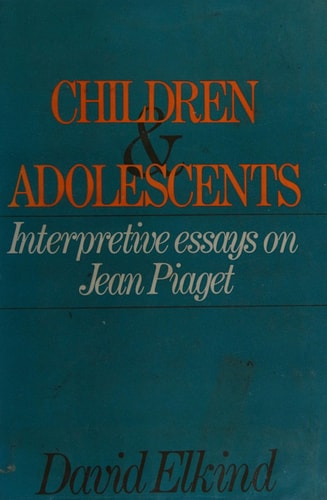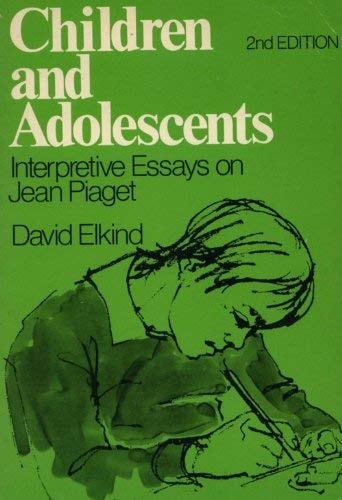
Children and Adolescents: Interpretive Essays on Jean Piaget
0
0
As an Amazon Associate and affiliate partner, Menrva Books earns from qualifying purchases. Learn more
Author Description
The work of the Swiss psychologist/philosopher Jean Piaget on the development of human intelligence is regarded as a momentous contribution to psychology and social science, equal in scope and impact to that of Freud on personality development. Piaget's theories of cognitive growth and structure are based on more than fifty years of empirical research and experiment with children of all ages, including his own three children from their infancy. Simply stated, his conception of intellectual growth is that "the child discovers conservation-permanence across apparent change-with the aid of reason. It is by reasoning about his experience that the child is able to overcome illusions and discover how things really are. The simplicity of this conclusion should not detract from its significance or from its radical opposition to prevalent views about the growth of intelligence. Piaget is arguing that knowledge about reality is not attributable entirely to experience (the action of things upon us) but also to reason (our mental actions upon things)." The author first presents the basic Piagetian concepts-assimilation, accommodation, equilibration, cognitive structures, mental operations, and schema. He then describes the periods into which Piaget's work falls and outlines the stages of intelligence development as Piaget understands them. Of eleven essays, some are concerned with interpreting the main ideas and findings of Piaget's work for a general audience; others deal with the implications of his ideas for child rearing, education, and clinical practice.
Menrva's Summary
THE THESIS
This book investigates the core question of how Jean Piaget’s theories of cognitive development can be interpreted and applied to understand the intellectual growth of children and adolescents. David Elkind, a prominent developmental psychologist, synthesizes decades of Piagetian research to clarify complex concepts such as assimilation, accommodation, and cognitive structures. By bridging the gap between empirical research and practical application, the author provides a framework for understanding how children use reason to navigate their reality. The text serves as both an introduction to Piaget’s foundational work and an exploration of its implications for modern education and clinical practice.
THE SCOPE MAP
What You Will Find
- Detailed explanations of core Piagetian concepts including schema, mental operations, and equilibration.
- A chronological breakdown of the developmental stages of intelligence from infancy through adolescence.
- Analysis of the intersection between empirical research and child-rearing practices.
- Practical applications of cognitive theory within educational and clinical settings.
THE AUTHORITY PERSPECTIVE
Experts and educators frequently cite this work as a foundational text for those seeking to understand Piaget’s complex theories in an accessible format. Readers often note that the essays provide a clear, structured entry point into the academic density of Piaget’s original research.
Page Count:
186
Publication Date:
1974-01-01
Publisher:
Oxford University Press
ISBN-10:
0195017803
ISBN-13:
9780195017809
Non-Fiction
Psychology
Education