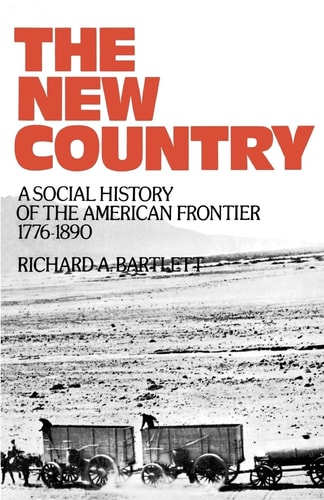
The New Country: A Social History of the American Frontier 1776-1890
0
0
As an Amazon Associate and affiliate partner, Menrva Books earns from qualifying purchases. Learn more
Author Description
From borax mule trains to the canoe stop that was Chicago in the 1830s, this book vividly recreated the tale of the westward movement of pioneers into the heartland of North America. With nearly a century separating historian Richard Bartlett from the end of the movement, Bartlett's broad perspective stresses the continuity and inevitability of this greatest element of America's Golden Age. The book focuses on the settlement of the country, the racial and ethnic composition of the people, agriculture, transportation, developments of the land, the growth of towns and cities, and the nature of frontier society as it brilliantly brings to life the frontier experience as lived by millions of Americans. Bartlett concludes that the pioneer's freedom from restrictions in a new country resulted in the unprecedented burst of energy that settled America in some 114 years.
Menrva's Summary
THE THESIS
This work investigates the social dynamics and developmental patterns that defined the American westward expansion between 1776 and 1890. Richard A. Bartlett, a historian specializing in the American West, utilizes a broad analytical framework to examine how the absence of traditional societal restrictions fostered a unique environment for rapid settlement. By synthesizing data on demographics, infrastructure, and agricultural evolution, the author argues that the frontier experience was a primary driver of American national identity and economic energy.
THE SCOPE MAP
What You Will Find
- Analysis of the demographic shifts and ethnic composition of frontier populations.
- Examination of transportation networks, including mule trains and early urban centers like Chicago.
- Historical assessment of agricultural development and land utilization patterns.
- Evaluation of the social structures and daily life experiences of pioneers during the 19th century.
THE AUTHORITY PERSPECTIVE
Historians and scholars frequently cite this text as a comprehensive overview of the social realities of the American frontier. Readers often note that the prose balances academic rigor with a narrative style that effectively illustrates the scale of the westward movement.
Page Count:
512
Publication Date:
1976-02-12
Publisher:
Oxford University Press
ISBN-10:
0195020219
ISBN-13:
9780195020212
History
Social History
American History
Westward Expansion
Frontier
Community Tags
Similar Books