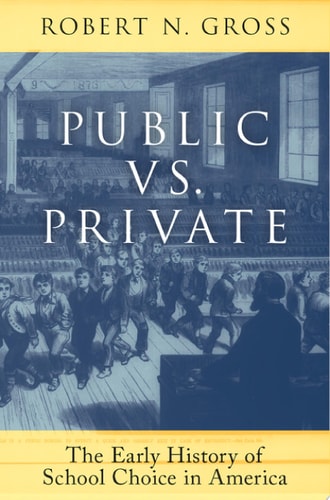
Public vs. Private: The Early History of School Choice in America
0
0
As an Amazon Associate and affiliate partner, Menrva Books earns from qualifying purchases. Learn more
Author Description
Americans today choose from a dizzying array of schools, loosely lumped into categories of "public" and "private." How did these distinctions emerge in the first place, and what do they tell us about the more general relationship in the United States between public authority and private enterprise? In Public vs. Private, Robert N. Gross describes how, more than a century ago, public policies fostered the rise of modern school choice. In the late nineteenth century, American Catholics began constructing rival, urban parochial school systems, an enormous and dramatic undertaking that challenged public school systems' near-monopoly of education. In a nation deeply committed to public education, mass attendance in Catholic schools produced immense conflict. States quickly sought ways to regulate this burgeoning private sector and the competition it produced, even attempting to abolish private education altogether in the 1920s. Ultimately, however, Gross shows how the public policies that resulted produced a stable educational marketplace, where choice flourished. The creation of the educational marketplace that we have inherited today--with systematic alternatives to public schools--was as much a product of public power as of private initiative. Gross also demonstrates that schools have been key sites in the development of the American legal conceptions of "public" and "private". Landmark Supreme Court cases about the state's role in regulating private schools, such as the 1819 Dartmouth v. Woodward decision, helped define and redefine the scope of government power over private enterprise. Judges and public officials gradually blurred the meaning of "public" and "private," contributing to the broader shift in how American governments have used private entities to accomplish public aims. As ever more policies today seek to unleash market forces in education, Americans would do well to learn from the historical relationship between government, markets, and schools.
Menrva's Summary
THE THESIS
This book investigates the historical origins of the American school choice system and the evolving legal relationship between public authority and private educational enterprise. Robert N. Gross, a historian, utilizes archival research and legal analysis to argue that the modern educational marketplace was not an organic development but a deliberate outcome of public policy. He demonstrates that the tension between Catholic parochial schools and state systems in the late nineteenth and early twentieth centuries forced a redefinition of government power that continues to influence contemporary policy.
THE SCOPE MAP
What You Will Find
- The rise of Catholic parochial school systems in the late nineteenth century.
- Analysis of landmark legal precedents including Dartmouth v. Woodward.
- Historical examination of state efforts to regulate or abolish private education in the 1920s.
- The evolution of the legal distinction between public and private sectors.
Scope Limits
- The book does not provide a comprehensive history of all private schooling models, focusing primarily on the Catholic-public school conflict.
- It does not offer a policy prescription for modern school choice debates, remaining focused on historical analysis.
THE AUTHORITY PERSPECTIVE
Scholars and historians recognize this work as a significant contribution to the understanding of how American legal frameworks shaped the modern educational landscape. Readers frequently note the academic density of the prose and the author's meticulous use of legal history to explain current policy structures.
Page Count:
220
Publication Date:
2017-01-01
Publisher:
Oxford University Press
ISBN-10:
0190644591
ISBN-13:
9780190644598
History
Religion
Public Policy
Legal History
Education
Education - History
United States
School choice
Educational Foundations
American History
Professional Career & Trade
Public schools
Educational Reform
Community Tags
Other Editions(2)
Similar Books
Reader Comments
Share Your Thoughts
No comments yet. Be the first to share your thoughts!