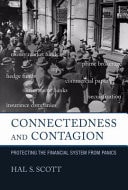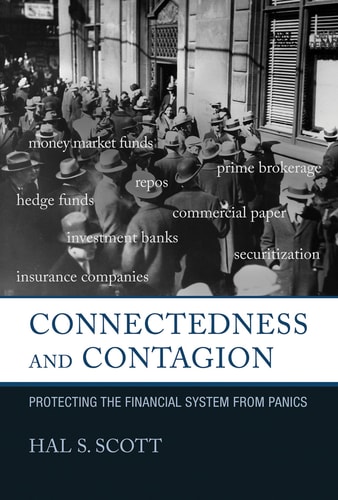
Connectedness and Contagion: Protecting the Financial System from Panics
0
0
As an Amazon Associate and affiliate partner, Menrva Books earns from qualifying purchases. Learn more
Author Description
An argument that contagion is the most significant risk facing the financial system and that Dodd¬Frank has reduced the government's ability to respond effectively. The Dodd–Frank Act of 2010 was intended to reform financial policies in order to prevent another massive crisis such as the financial meltdown of 2008. Dodd–Frank is largely premised on the diagnosis that connectedness was the major problem in that crisis—that is, that financial institutions were overexposed to one another, resulting in a possible chain reaction of failures. In this book, Hal Scott argues that it is not connectedness but contagion that is the most significant element of systemic risk facing the financial system. Contagion is an indiscriminate run by short-term creditors of financial institutions that can render otherwise solvent institutions insolvent. It poses a serious risk because, as Scott explains, our financial system still depends on approximately $7.4 to $8.2 trillion of runnable and uninsured short-term liabilities, 60 percent of which are held by nonbanks. Scott argues that efforts by the Federal Reserve, the FDIC, and the Treasury to stop the contagion that exploded after the bankruptcy of Lehman Brothers lessened the economic damage. And yet Congress, spurred by the public's aversion to bailouts, has dramatically weakened the power of the government to respond to contagion, including limitations on the Fed's powers as a lender of last resort. Offering uniquely detailed forensic analyses of the Lehman Brothers and AIG failures, and suggesting alternative regulatory approaches, Scott makes the case that we need to restore and strengthen our weapons for fighting contagion.
Menrva's Summary
THE THESIS
This book argues that contagion, not connectedness, is the primary systemic risk facing the financial system, and that current regulations have weakened the government's ability to combat it. Hal S. Scott, a recognized authority in financial regulation, posits that while the Dodd-Frank Act aimed to prevent crises by addressing interconnectedness, it has inadvertently diminished the tools available to manage indiscriminate runs by short-term creditors. The book details how approximately $7.4 to $8.2 trillion in runnable, uninsured short-term liabilities, largely held by nonbanks, remain vulnerable. Scott analyzes the failures of Lehman Brothers and AIG to illustrate his points and proposes alternative regulatory strategies to restore the government's capacity to fight financial contagion.
THE SCOPE MAP
- Analysis of systemic risk, distinguishing between connectedness and contagion.
- Forensic examination of the Lehman Brothers and AIG failures.
- Discussion of the role and limitations of the Federal Reserve, FDIC, and Treasury in crisis response.
- Critique of the Dodd-Frank Act's impact on government's ability to combat financial panics.
- Examination of approximately $7.4 to $8.2 trillion in runnable, uninsured short-term liabilities.
- Proposal of alternative regulatory approaches to strengthen defenses against contagion.
- The specific vulnerabilities of nonbank financial institutions in the current system.
THE AUTHORITY PERSPECTIVE
The book presents a strong argument that contagion, characterized by runs on short-term creditors, poses a greater threat to financial stability than mere interconnectedness. Scott's analysis, grounded in the failures of Lehman Brothers and AIG, suggests that current regulatory frameworks, particularly those stemming from the Dodd-Frank Act, have curtailed the government's essential crisis-fighting powers. The work is likely to be of interest to policymakers, financial professionals, and academics concerned with financial stability and regulatory reform. It advocates for a restoration and strengthening of the tools available to combat systemic financial panics.
Page Count:
440
Publication Date:
2022-11-01
Publisher:
MIT Press
ISBN-10:
0262546752
ISBN-13:
9780262546751
Economics
Business
Non-Fiction
Regulation
Finance
Law