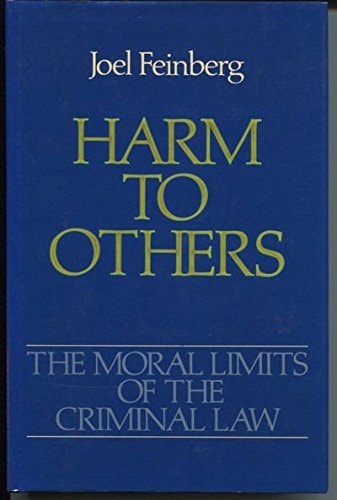
Harm to Others: Moral Limits of the Criminal Law, Vol. 1
0
0
As an Amazon Associate and affiliate partner, Menrva Books earns from qualifying purchases. Learn more
Author Description
In this volume, Feinberg focuses on the meanings of "interest," the relationship between interests and wants, and the distinction between want-regarding and ideal-regarding analyses on interest and hard cases for the applications of the concept of harm. Examples of the "hard cases" are harm to character, vicarious harm, and prenatal and posthumous harm. Feinberg also discusses the relationship between harm and rights, the concept of a victim, and the distinctions of various quantitative dimensions of harm, consent, and offense, including the magnitude, probability, risk, and "importance" of harm.
Menrva's Summary
THE THESIS
This volume investigates the conceptual boundaries of harm as a justification for state intervention within the framework of criminal law. Joel Feinberg, a prominent legal philosopher, utilizes analytical jurisprudence to dissect the relationship between individual interests and the state's authority to restrict liberty. By examining the nuances of want-regarding and ideal-regarding interests, he establishes a rigorous taxonomy for determining when an action qualifies as a harm sufficient to warrant legal prohibition.
THE SCOPE MAP
What You Will Find
- A detailed analysis of the distinction between interests and wants in legal theory.
- Examination of complex harm scenarios including prenatal, posthumous, and vicarious harm.
- A framework for evaluating the magnitude, probability, and risk associated with harmful actions.
- Discussion on the intersection of harm, rights, and the concept of a victim in criminal jurisprudence.
THE AUTHORITY PERSPECTIVE
Legal scholars and philosophers frequently cite this work as a foundational text for understanding the harm principle in modern liberal societies. Readers often note the high level of analytical density, making it a standard reference for advanced students of jurisprudence and political theory.
Page Count:
284
Publication Date:
1984-07-05
Publisher:
Oxford University Press
ISBN-10:
0195034090
ISBN-13:
9780195034097
Philosophy
Law
Criminal Law
Jurisprudence
Ethics
Law Philosophy
Crimes without victims
Community Tags
Similar Books