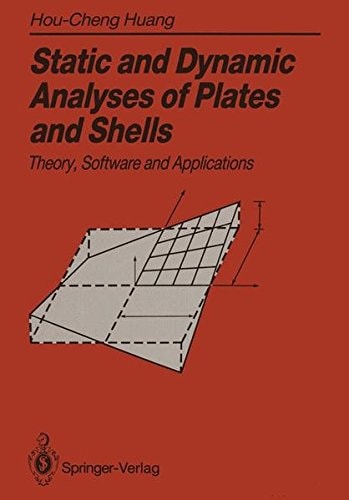
Static and Dynamic Analyses of Plates and Shells: Theory, Software and Applications
0
0
As an Amazon Associate and affiliate partner, Menrva Books earns from qualifying purchases. Learn more
Author Description
Over the past decade or so much has been written on the various attempts to produce efficient, accurate and reliable Mindlin plate finite elements. In the late sixties, a degenerated, Mindlin-type, curved shell element was developed and subsequently many improvements in such elements have been made. Reliability and efficiency in use has always been a major objective. Degenerated shell elements have enjoyed widespread popularity despite certain potential defects, including shear and membrane lock ing behaviour and spurious mechanisms. After introducing the basic foundations of Mindlin-type elements, this book describes these defects and also gives the reasons for their occurrence. Furthermore, the author proposes an approach to overcome these defects. A series of linear benchmark tests are proposed to illustrate the performance of the assumed strain element formulations. The formula tions and applications for material non-linearity are also presented. Both isotropic and anisotropic material models are included together with the results for both static and transient dynamic analyses. Two associated programs are fully documented and provided on floppy discs with test examples. Source codes for the two associated programs are provided: one is for static analysis and the other for dynamic analysis, and the programs can be compiled and run on either a mini or mainframe coniputer via a terminal. The author hopes that this book may provide further impetus in the important research area of plate and shell element technology.
Menrva's Summary
THE THESIS
This book investigates the development and application of efficient and accurate Mindlin plate finite elements for static and dynamic analyses of plates and shells. The author, Hou-Cheng Huang, addresses common defects in degenerated shell elements, such as shear and membrane locking, and proposes a novel approach to overcome them. The text details linear benchmark tests for assumed strain element formulations and extends these to material non-linearity, covering both isotropic and anisotropic materials. Two fully documented computer programs for static and dynamic analysis are provided, with source codes, to facilitate practical application and further research in plate and shell element technology.
THE SCOPE MAP
- Detailed explanation of Mindlin-type plate and shell finite elements.
- Analysis of defects in degenerated shell elements, including shear and membrane locking.
- Proposed methodology to overcome identified defects in finite element formulations.
- Linear benchmark tests to evaluate assumed strain element performance.
- Formulations and applications for material non-linearity (isotropic and anisotropic).
- Static and transient dynamic analysis results.
- Documentation and source code for two associated programs: one for static analysis, one for dynamic analysis.
- Discussion on the research area of plate and shell element technology.
THE AUTHORITY PERSPECTIVE
The book aims to provide further impetus in the research area of plate and shell element technology by presenting novel approaches to overcome common defects in finite element formulations. The inclusion of documented programs and source codes suggests a practical focus, intended to aid researchers and practitioners in applying these advanced techniques. The detailed analysis of theoretical defects alongside practical solutions indicates a text geared towards specialists in structural mechanics and computational engineering.
Page Count:
194
Publication Date:
1989-05-01
Publisher:
Springer
ISBN-10:
3540195386
ISBN-13:
9783540195382
Non-Fiction
Science
Computational Mechanics
Engineering
Applied Mathematics
Structural analysis
Community Tags
Similar Books