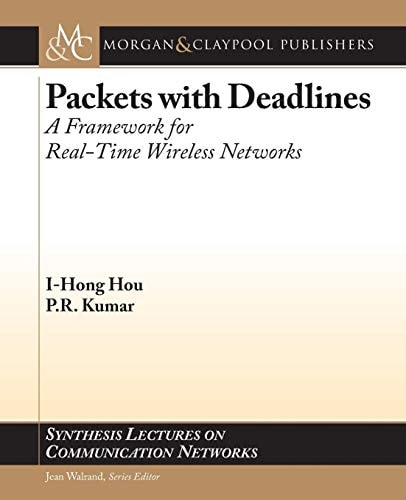
Packets with Deadlines: A Framework for Real-time Wireless Networks
0
0
As an Amazon Associate and affiliate partner, Menrva Books earns from qualifying purchases. Learn more
Author Description
With the explosive increase in the number of mobile devices and applications, it is anticipated that wireless traffic will increase exponentially in the coming years. Moreover, future wireless networks all carry a wide variety of flows, such as video streaming, online gaming, and VoIP, which have various quality of service (QoS) requirements. Therefore, a new mechanism that can provide satisfactory performance to the complete variety of all kinds of flows, in a coherent and unified framework, is needed. In this book, we introduce a framework for real-time wireless networks. This consists of a model that jointly addresses several practical concerns for real-time wireless networks, including per-packet delay bounds, throughput requirements, and heterogeneity of wireless channels. We detail how this framework can be employed to address a wide range of problems, including admission control, packet scheduling, and utility maximization. Table of Contents: Preface / Introduction / A Study of the Base Case / Admission Control / Scheduling Policies / Utility Maximization without Rate Adaptation / Utility Maximization with Rate Adaptation / Systems with Both Real-Time Flows and Non-Real-Time Flows / Broadcasting and Network Coding / Bibliography / Authors' Biographies
Menrva's Summary
THE THESIS
This book introduces a novel framework designed to manage the diverse quality of service requirements of future wireless networks. The authors address the challenge of increasing wireless traffic and the need for a unified mechanism to handle various flows, such as video streaming, online gaming, and VoIP, each with distinct demands. The proposed framework models per-packet delay bounds, throughput requirements, and the heterogeneity of wireless channels to provide satisfactory performance across all flow types.
THE SCOPE MAP
- A model that jointly addresses per-packet delay bounds, throughput requirements, and channel heterogeneity.
- Detailed explanations of how the framework applies to admission control.
- Methods for packet scheduling within the framework.
- Techniques for utility maximization, both with and without rate adaptation.
- Consideration of systems that include both real-time and non-real-time flows.
- Discussion on broadcasting and network coding in real-time wireless networks.
THE AUTHORITY PERSPECTIVE
The framework presented in this book is designed to tackle the complex demands of modern wireless networks, suggesting a focus on practical, implementable solutions for researchers and engineers. The detailed table of contents indicates a thorough exploration of core problems in real-time wireless communication, from basic models to advanced utility maximization strategies. The inclusion of both real-time and non-real-time flows, as well as broadcasting, points to a comprehensive approach to network management. The structure suggests a text that is both theoretically rigorous and practically oriented, aiming to provide a solid foundation for future network design.
Page Count:
106
Publication Date:
2013-01-01
Publisher:
Morgan & Claypool
ISBN-10:
1627050892
ISBN-13:
9781627050890
Science
Non-Fiction
Computer Science
Networking
Wireless Communication
Community Tags
Similar Books