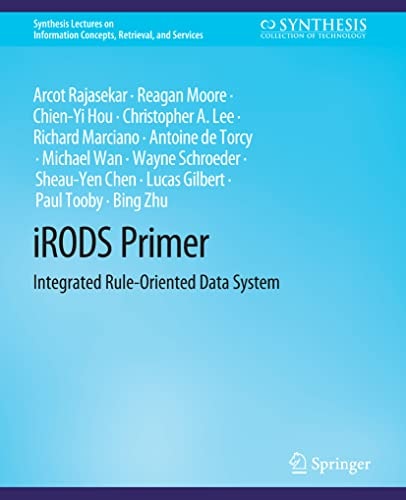
iRODS Primer: Integrated Rule-Oriented Data System
0
0
As an Amazon Associate and affiliate partner, Menrva Books earns from qualifying purchases. Learn more
Author Description
Policy-based data management enables the creation of community-specific collections. Every collection is created for a purpose. The purpose defines the set of properties that will be associated with the collection. The properties are enforced by management policies that control the execution of procedures that are applied whenever data are ingested or accessed. The procedures generate state information that defines the outcome of enforcing the management policy. The state information can be queried to validate assessment criteria and verify that the required collection properties have been conserved. The integrated Rule-Oriented Data System implements the data management framework required to support policy-based data management. Policies are turned into computer actionable Rules. Procedures are composed from a Micro-service-oriented architecture. The result is a highly extensible and tunable system that can enforce management policies, automate administrative tasks, and periodically validate assessment criteria. Table of Contents: Introduction / Integrated Rule-Oriented Data System / iRODS Architecture / Rule-Oriented Programming / The iRODS Rule System / iRODS Micro-services / Example Rules / Extending iRODS / Appendix A: iRODS Shell Commands / Appendix B: Rulegen Grammar / Appendix C: Exercises / Author Biographies
Menrva's Summary
THE THESIS
The Integrated Rule-Oriented Data System (iRODS) provides a framework for policy-based data management, enabling the creation of specialized collections with enforced properties. This system translates management policies into computer-actionable rules and composes procedures from a micro-service-oriented architecture. It aims to create an extensible and tunable system capable of enforcing policies, automating administrative tasks, and validating assessment criteria. The core concept revolves around defining data collection purposes, associating properties, and enforcing these through management policies that control data access and ingestion.
THE SCOPE MAP
- The fundamental principles of policy-based data management.
- An in-depth explanation of the Integrated Rule-Oriented Data System (iRODS) architecture.
- Concepts and implementation of rule-oriented programming within iRODS.
- Details on the iRODS rule system and its micro-services.
- Practical examples of iRODS rules and how to extend the system.
- Appendices covering iRODS shell commands, the Rulegen grammar, and exercises.
THE AUTHORITY PERSPECTIVE
This text serves as a foundational guide to the iRODS framework, detailing its architecture and operational principles for managing data through policies and rules. It is structured to provide both theoretical understanding and practical application for users and administrators. The inclusion of a table of contents with specific sections on architecture, rule systems, and extensions indicates a comprehensive approach to understanding and implementing iRODS.
Page Count:
143
Publication Date:
2010-01-01
Publisher:
Springer International Publishing
ISBN-10:
3031011430
ISBN-13:
9783031011436
Non-Fiction
Science & Technology
Information Systems
Computer Science
Community Tags
Similar Books