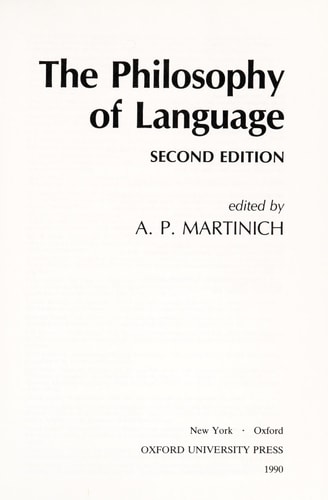
The Philosophy of Language
0
0
As an Amazon Associate and affiliate partner, Menrva Books earns from qualifying purchases. Learn more
Author Description
What is meaning? What is the relationship between language and the world? How is linguistic communication possible? This comprehensive anthology contains thirty-seven of the most important articles in the philosophy of language, including both classic articles by such philosophers as Gottlob Frege, Bertrand Russell, J.L. Austin, W.V. Quine, and P.F. Strawson and recent work by Saul Kripke, David Kaplan, Donald Davidson, David Lewis, John Searle, and Noam Chomsky. The Second Edition includes six new selections by Russell, Searle, H.P. Grice, Robert Stalnaker, Hilary Putnam, and Chomsky.Clearly structured in a way that both students and teachers will find appealing, the new edition is divided into seven sections that cover all of the central issues in the philosophy of Truth and Meaning, Speech Acts, Reference and Descriptions, Names and Demonstratives, Propositional Attitudes, Metaphor, and The Nature of Language. The articles included represent a range of different approaches to the philosophy of language and many build upon or discuss previous articles. Expanded introductions to each section provide the background necessary for understanding the philosophical issues and the connections between the articles. A bibliography of suggested further reading is included at the end of each section. Reorganized and consolidated for easier accessibility, and with new material throughout, The Philosophy of Language, Second Edition, is an essential text for courses in the philosophy of language, linguistic studies, semantics, and rhetoric.
Menrva's Summary
THE THESIS
This anthology investigates the fundamental nature of meaning, the connection between language and reality, and the mechanisms that facilitate human communication. A.P. Martinich, a scholar in the field, curates a collection of thirty-seven seminal essays that trace the development of linguistic philosophy from classical foundations to contemporary discourse. The text provides a structured framework for analyzing how language functions as a system of reference, truth, and social interaction.
THE SCOPE MAP
What You Will Find
- A comprehensive selection of thirty-seven foundational and modern philosophical articles.
- Seven thematic sections covering Truth, Meaning, Speech Acts, Reference, Names, Propositional Attitudes, and Metaphor.
- Editorial introductions for each section that contextualize the historical and logical connections between authors.
- Bibliographies for further research and study at the end of each thematic division.
THE AUTHORITY PERSPECTIVE
Experts and educators frequently identify this anthology as a primary resource for undergraduate and graduate courses in philosophy and linguistics. Readers often note the academic density of the prose, which is balanced by the clear organizational structure that aids in navigating complex analytical arguments.
Page Count:
512
Publication Date:
1985-02-14
Publisher:
Oxford University Press
ISBN-10:
0195035534
ISBN-13:
9780195035537
Philosophy
Academic
Linguistics
Semantics
Reference
Community Tags
Similar Books